
Roof Repair vs. Replace: How to Make the Call
By RoofPredict Research TeamUpdated 57 min readMethodology
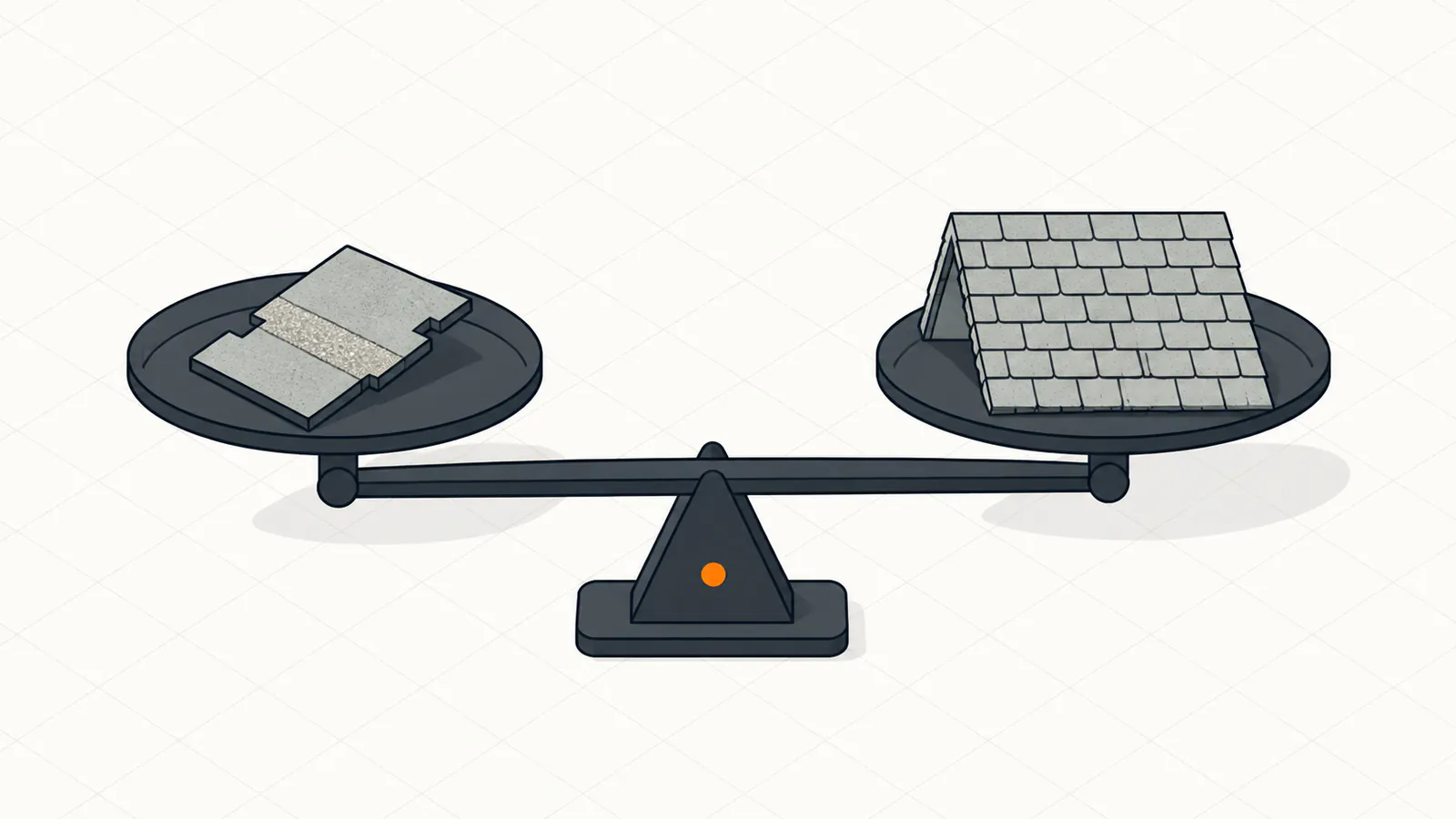
Repair when the damage is localized and the roof has five or more years of expected life left. Replace when wear is widespread, the roof is at or past its typical lifespan, or repairs would cost roughly 25 to 30 percent of a new roof. Age plus damage extent settles most cases.
Key takeaways
- Two variables settle most repair-or-replace decisions: how old the roof is relative to its expected life, and whether the damage sits in one place or shows up everywhere.
- A widely used industry rule of thumb says that once repairs approach 25 to 30 percent of replacement cost (or damage covers that share of the roof), replacement is usually the better use of money.
- The Years-Bought Test cuts through confusion: divide the repair price by the years it honestly buys, then compare that number to a replacement's cost spread over its full expected life.
- A repair is an investment on a roof with five or more years left and a donation on a roof with two; the same $900 fix can be either, depending only on the roof under it.
- Layovers and partial replacements are tempting middle paths that usually cost more over their full life than they save up front.
- Insurance and resale pressures tend to point the same direction on an older roof: toward replacement on your schedule rather than a leak's.
- Structural findings outrank the whole framework. Soft or sagging decking in more than one place makes replacement urgent no matter which age band the roof sits in.
- When the matrix says gray zone, buy a written condition report from someone who is not bidding the job, then run the numbers before you sign anything.
Want this answered for your property? Request a free Roof Report, then review the findings and open questions by phone with RoofPredict.
Should you repair or replace your roof?
Here is the direct answer. Repair when the damage is confined to one or two identifiable spots (a flashing, a vent boot, a patch of wind-lifted shingles) and the roof has at least five years of expected life left. Replace when the wear shows up across most of the roof, when the roof is at or past the typical lifespan for its material, or when the repair estimate climbs toward 25 to 30 percent of what a full replacement would cost. Those three tests resolve the large majority of cases in a few minutes, before a single contractor sets foot on a ladder.
Everything else, the genuinely hard cases, lives in a gray zone this page is built to shrink. The tools are simple. The Repair-or-Replace Matrix crosses your roof's age with the extent of the damage and hands you an answer for most combinations. The 30 percent rule tells you when a repair bill has gotten large enough to stop and compare. The Years-Bought Test turns "repair now or replace now" into plain arithmetic. And a 12-question scorecard at the end lets you grade your own roof the way an experienced inspector would, before anyone with a sales quota grades it for you.
The short version
A repair buys time. The whole decision is how much time, at what price, on a roof that will need replacing eventually anyway. A $900 flashing repair that gives a 10-year-old roof another decade of quiet service is one of the best deals in homeownership. The identical repair on a 24-year-old roof that is shedding granules buys a year or two, and then you pay for the replacement too, flashing included.
One reassurance before the frameworks: needing a repair is normal, and even needing a replacement is not an emergency in most cases. Roofs rarely fail all at once. They announce themselves with months or years of warning: a stain, a leak, a shingle in the yard. The homeowners who get hurt financially are not the ones with old roofs; they are the ones who decide under pressure, at the top of a stranger's ladder, with no independent read on what the roof actually needs. This page exists so that person is never you.
The Repair-or-Replace Matrix: age crossed with damage extent
Find your roof's age band in the left column, find the column that matches how much of the roof is affected, and the cell is the answer. Everything below hangs off this one table.
| Roof age (asphalt) | Localized damage (1–2 spots) | Moderate damage (one slope or region) | Widespread wear or damage |
|---|---|---|---|
| Under 10 years | Repair zone. Likely a storm hit or an install defect; check the workmanship warranty and your policy before paying out of pocket. | Repair zone, with a question. A young roof with a regional problem usually points to installation error, so pursue the installer first. | Gray zone, and unusual. Suspect a defective product or a bad install. Push the manufacturer and installer before spending your own money. |
| 10–15 years | Repair zone. Good value; the roof has roughly a decade of expected life left. | Repair zone, leaning gray. Repair or partial replacement can work if the rest of the roof checks out — get a full condition report first. | Gray zone, leaning replace. Widespread wear this early usually means a ventilation problem or a short-lived product; fix the cause when you re-roof. |
| 15–20 years | Repair zone, with homework. Fix it, get a remaining-life estimate in writing, and start a replacement fund either way. | Gray zone: the classic hard case. Apply the 30 percent rule and the Years-Bought Test, and read your insurer's roof terms now. | Replace zone. You would be buying years the roof cannot give back; put the repair money toward the new roof. |
| 20+ years | Gray zone. Repair only if it is cheap and buys a specific, short stretch — through a winter, or through a sale. | Replace zone. A moderate repair at this age almost never pays for itself. | Replace zone. Every additional repair dollar is a donation. |
Read the diagonal and you will see the logic. The top-left of the matrix is repair country: young roof, small problem, obvious answer. The bottom-right is replace country: old roof, big problem, equally obvious. The decision only gets interesting along the middle diagonal: a 16-year-old roof with one damaged slope, a 12-year-old roof with wear showing everywhere. That is exactly where the 30 percent rule, the Years-Bought Test, and an independent inspection earn their keep. If your situation lands in a repair or replace cell, you can honestly skip to the sections about doing that well. If you land in the gray, the next several sections were written for you.
Two adjustments before you trust your cell. First, the age bands above are for asphalt shingles, the material on roughly four out of five American homes. For metal, tile, and slate, stretch the bands considerably, and remember that on those materials the visible surface is rarely what fails. Fasteners, sealants, flashings, and the underlayment beneath tile are the serviceable parts, so "repair" on a 30-year-old metal roof can be substantial, sensible work rather than a last rite. Second, the matrix assumes you actually know the roof's age, at least within a few years. If you do not, that is the single highest-value fact you can establish, and our roof lifespan guide walks the whole age-hunting sequence.
A note on the matrix's limits. No table can see soft decking from your driveway, so it will never stand in for someone competent physically checking the roof. What it does replace is deciding from a single contractor's verdict, delivered in your kitchen, with a discount that expires at dinner. Use the matrix to know what answer to expect before anyone bids, and treat a bid that lands far from the expected cell as a prompt for a second opinion rather than a reason to panic.
How do you tell localized damage from widespread wear?
The quickest honest test: can you circle the problem in one spot on a photo of your roof? A leak at the chimney, a cracked vent boot, a fist-sized patch of missing shingles after a windstorm: those circle cleanly, and they are localized by definition. Granules collecting in gutters on every side of the house, shingle edges curling on two or three slopes, dark bald streaks scattered across the whole surface. Those do not circle, because they are not damage in one place. They are the surface itself wearing out, everywhere, at roughly the same rate.
The distinction matters more than any other single observation, because it separates two different kinds of problem. Localized damage has a cause you can name (a storm gust, a raccoon, a nail that backed out, a flashing that was bent on day one), and fixing the cause fixes the roof. Widespread wear has only one cause, which is time, and no repair addresses time. This is why an honest roofer will happily fix a torn boot on a worn roof but will not promise the fix means anything: the boot was never the problem. Our guide to the warning signs of a failing roof walks each symptom in detail; the table below sorts the common ones into the two buckets.
| What you see | Usually counts as | Typical cause | Sensible first move |
|---|---|---|---|
| Leak at a chimney, skylight, or wall | Localized | Flashing failure, often years before the shingles fail | Reflash properly; this is the classic good repair |
| Cracked or split rubber ring on a vent pipe | Localized | UV aging of the boot, not the roof | Replace the boot; among the cheapest fixes in roofing |
| A handful of missing or lifted shingles, one area | Localized | Wind event, or a bad nailing line from install day | Repair and match; check whether a storm claim applies |
| Hail bruising concentrated on one or two slopes | Localized to moderate | One storm, directional | Document it and read our storm-claim guidance before repairing |
| Granules filling gutters on every side, bald spots | Widespread | Age; the shingle surface is depleting | Stop pricing repairs; start pricing replacement timing |
| Curling, clawing, or cupping edges on multiple slopes | Widespread | Age, heat, and often poor attic ventilation | Replacement conversation, plus fix the ventilation cause |
| Leaks in different rooms, different seasons | Widespread | The surface or underlayment failing generally | Apply the Second-Leak Rule described below |
| Sagging ridge line or spongy areas underfoot | Structural, its own category | Decking or framing damage, often from long-term moisture | Get a professional evaluation now; this outranks every matrix cell |
Two cautions on reading your own roof. First, moss and algae streaks look alarming and are mostly cosmetic (dark streaks in particular are a common algae discoloration rather than a failure sign), so do not let a green or streaked roof stampede you toward replacement on looks alone. Second, the opposite error is just as common: a roof can read fine from the ground while the flashing, the fastener seals, and the deck tell a different story up close. Ground-level triage is for sorting yourself into a matrix column, not for final answers. When the column is "moderate" or worse, the final answer should come from someone standing on the roof, or from detailed roof imagery reviewed by someone who knows what to look for.
Why does the roof's age dominate the decision?
Because every repair is a bet on the roof around it. A perfect chimney reflash is warrantied by the roof it is attached to: if the shingles around it have twelve years left, the repair delivers twelve years of value; if they have two, the repair delivers two, at the same price. That is the entire reason age anchors the left edge of the matrix.
The damage tells you what a repair would cost. The age tells you what the repair would be worth.
The age bands rest on well-worn industry figures. The reference most professionals still cite is the National Association of Home Builders' Study of Life Expectancy of Home Components, published in 2007, which put asphalt shingles at roughly 20 years and premium materials far higher. It is a survey of expert opinion rather than a tracking study, and nearly two decades old now, but still broadly consistent with what inspectors and insurers report. Real-world experience with today's architectural shingles generally runs 20 to 30 years, three-tab shingles 15 to 20, with climate and installation quality regularly moving a specific roof five years either way. Our roof lifespan guide covers the full material-by-material picture, including the Three Clocks framework for judging which failure mode your roof will hit first.
If you do not know the roof's age, closing documents, county permit records, a longtime neighbor, and historical roof imagery will usually bracket it within a few years in well under an hour; the how-long guide walks that hunt step by step.
Turn age into the number the matrix actually needs: expected life remaining. Take a realistic lifespan for your material and climate, subtract the age, then let an inspection adjust the result. A well-ventilated 18-year-old roof in a mild climate can be a better repair candidate than a baked, hail-pocked 12-year-old one. And keep the number in perspective, because plenty of 22-year-old roofs are quietly sound. The point of knowing the age is to make sure the replacement, whenever it comes, happens on your calendar and your terms rather than a leak's.
What is the 30 percent rule for roof replacement?
The rule, in its common form: when the cost of repairs approaches roughly 25 to 30 percent of the cost of a full replacement, replace instead. You will hear a second form aimed at area rather than dollars (if about a third of the roof surface is damaged or worn, replace), and both versions circulate among contractors and adjusters as received wisdom. Be clear about what it is: an industry rule of thumb, not a building-code requirement, not an insurance regulation, and not a law of physics. It survives because it compresses a real economic truth into a number you can hold in your head.
The truth it compresses has two parts. First, small roofing jobs are expensive per square foot, because every job, however small, carries the same fixed costs: a crew's trip, ladder and safety setup, tear-in and tie-out around the damaged area, disposal, and the minimum billing that keeps a roofing company solvent. As the damaged area grows, you pay those fixed costs against more and more actual roofing, until at some point you are paying repair-grade prices for replacement-scale work. Second, a large repair is always paired with an aging roof, and the two purchases do not add up. Spend 30 percent of a replacement on a roof with a quarter of its life left, and you have bought a sliver of service at a premium. The full replacement bill is still coming, undiminished, a few years out.
A worked example
Say replacement bids for your roof come in around $15,000, near the middle of the national ranges. A $1,200 chimney reflash on a 12-year-old roof is 8 percent of replacement: clearly worth it. A $4,500 rebuild of one storm-damaged slope on a 19-year-old roof is 30 percent, spent on a roof with perhaps five years left. That is the case where most professionals, including ones who would profit from the repair, would tell you to put the $4,500 toward the new roof instead.
Use the rule as a tripwire, not a verdict. It exists to tell you when to stop and run the real comparison, and it has honest exceptions in both directions. A 30 percent repair on a 9-year-old roof with fifteen years ahead of it can be perfectly rational, because you are buying a long stretch of remaining life, and the Years-Bought Test in the next section will show it. Meanwhile a 15 percent repair on a 25-year-old roof usually fails the same test, even though the rule never fires. The percentage tells you when to think. The age band tells you what to think. The arithmetic below tells you what it is worth.
The Years-Bought Test: what a repair costs per year of dry house
The Years-Bought Test is one division problem, done twice. For the repair: divide the repair price by the number of years it honestly buys, meaning the years a disinterested inspector estimates rather than the years you hope for. For the replacement: divide the replacement price by the expected life of the new roof. Then compare the two numbers.
You are no longer choosing between a small bill and a big one. You are choosing between two prices for the same product, which is a year of dry house.
Set the baseline first. Most asphalt replacements nationally land between roughly $9,000 and $20,000, with cost surveys clustering around $10,000 to $15,000; our 2026 cost guide breaks down the ranges by material, size, region, and roof complexity. Take a $15,000 replacement delivering 25 years: that is $600 per year of roof. Every repair quote can now be measured against $600 a year. A $600 boot-and-flashing package that keeps a mid-life roof healthy for a decade costs $60 a year, a tenth the price of new roofing. A $3,000 patch campaign that drags a dying roof through two more winters costs $1,500 a year, two and a half times the price of simply buying the new roof those winters were delaying.
| Scenario | Repair cost | Years honestly bought | Repair price per year | Verdict vs. $600/yr |
|---|---|---|---|---|
| Vent boot replacement, 8-year-old roof | $300 | 12+ (rest of roof life) | ~$25 | Repair, obviously |
| Chimney reflash, 14-year-old roof | $1,200 | 10 | $120 | Repair, at a fifth the cost of new roofing |
| One-slope rebuild, 19-year-old roof | $4,500 | 4–5 | $900–$1,125 | Replace: the repair costs more per year than a new roof |
| Leak-chasing patches, 23-year-old roof | $1,000/year, recurring | 1 at a time | $1,000+ | Replace; you are renting a failing roof at a premium |
Three honest caveats keep the test from becoming false precision. First, "years bought" is an estimate, so run the math at both ends of the inspector's range; if the verdict flips within the range, you are genuinely in the gray zone and other factors (insurance, sale plans, cash on hand) get the deciding vote. Second, money now is not identical to money later: a $900-per-year repair can still be rational if it defers a $15,000 bill you cannot yet finance, and the financing section below addresses exactly that squeeze. Third, remember the double-pay trap: repair dollars do not reduce the eventual replacement price by a cent. The slope you rebuild this year gets torn off with everything else at replacement. The test's whole job is to make that overlap visible before you pay for it.
When is a roof repair clearly the right call?
A repair is the right call when three things are true at once: the problem has a cause you can name, the fix addresses that cause rather than covering its symptom, and the roof around the fix has enough life left to make the fix worth owning. Young roof, isolated damage, matching materials available. When that trio lines up, repairing is neither the cheap option nor the timid one. It is simply correct, and replacing instead would waste thousands of dollars of remaining roof life.
- Failed flashing at a chimney, skylight, sidewall, or valley on a roof under roughly 15 to 18 years old. Flashing routinely fails before shingles do, and a proper reflash is a durable, well-understood fix.
- A cracked plumbing-vent boot or loose exhaust cap. These cause a wildly disproportionate share of residential leaks and sit near the bottom of the price list.
- Wind damage confined to a small area (a handful of lifted or creased shingles, a ridge cap) on a roof whose remaining shingles are still sealed down.
- Hail damage limited to one slope when the rest of the roof shows none, documented with photos so any later claim has a baseline.
- A small section of decking replaced under a known, fixed leak, when the surrounding roof is sound and the leak's cause is corrected in the same visit.
- Ice-dam damage at an eave on a roof with life left, paired with the attic insulation and ventilation work that stops the dams from re-forming. Skip that part and the same repair returns next winter.
- Maintenance-scale items: resealing exposed fasteners, replacing a damaged pipe collar, reattaching drip edge. Cheap now, expensive to ignore.
One condition on the list above deserves its own sentence: matching materials must actually be available. If your shingle line has been discontinued (common on roofs past 15 years), a "small" repair becomes a visible checkerboard, and on some slopes a mismatch is more than cosmetic, because interweaving new shingles into brittle old ones multiplies breakage. A repair quote should name the shingle it will use and whether it matches; "close enough" is an answer you want to hear before the crew is on the roof, not after.
| Repair | Typical range (surveys, Aug 2026) | Worth knowing |
|---|---|---|
| Plumbing vent boot replacement | roughly $100–$600 | Often bundled with an inspection or other small fixes |
| Small shingle repair (one area) | roughly $150–$1,000 | Matching the shingle line is the real challenge, not the labor |
| Flashing repair or chimney reflash | roughly $300–$1,500 | Full masonry-chimney reflashing can exceed this on large chimneys |
| Valley repair | roughly $400–$2,000 | Valleys carry concentrated water; insist on the proper rebuild, not sealant |
| Localized decking replacement | roughly $500–$2,000 | Only priceable after tear-in; expect an allowance, not a fixed bid |
| Full single-slope re-roof | roughly $2,000–$7,000 | This is where the 30 percent rule starts firing; compare before signing |
When you do repair, buy the paper along with the work. Ask the contractor to confirm in writing what failed and what was done about it, with before-and-after photos, plus their estimate of the roof's remaining life. That file costs nothing, and it pays three ways: it satisfies a future buyer's inspector, it gives an insurance adjuster a maintenance history, and it turns your next repair-or-replace decision from guesswork into a trend line. A good repair roofer provides this gladly, because a documented happy customer today is who they expect to re-roof for in eight years.
Replacement triggers: the findings no repair reaches
Replacement is the right call when the roof's problems stop being events and become its condition. No single leak proves a roof is done, but certain findings are reliable verdicts, because each one means the failure is distributed across the whole surface. That is exactly the thing no repair can reach.
| Finding | Why it points to replacement | Can a repair help at all? |
|---|---|---|
| Widespread granule loss: gritty gutters, bald or shiny patches across slopes | Granules are the shingle's UV armor; once shed broadly, the asphalt beneath ages fast everywhere at once | No. There is no re-granulating a roof; coatings marketed for this are not a fix for shingles |
| Curling, clawing, or brittleness on multiple slopes | The shingle mat itself has aged; brittle shingles break under a repair crew's feet, so even small fixes cause damage | Barely; handle-with-care repairs can bridge a season, not more |
| Failed sealant strips, with shingles lifting in ordinary wind across the roof | The roof's wind resistance is gone as a system; every gusty day is a new repair | Hand-sealing helps briefly; the pattern always returns |
| Chronic leaks: a second unrelated leak within about two years | Leaks in different places mean the surface or underlayment is failing generally | Each patch works locally while the roof keeps failing globally |
| Two layers of shingles already on the roof | Model codes generally cap asphalt at two layers, so the next job is a full tear-off no matter what | Money spent patching the top layer is spent on borrowed time |
| Soft, sagging, or rotten decking in multiple areas | The structure under the shingles is compromised; new shingles over bad deck fail early and void workmanship warranties | No, and decking is far cheaper to fix while the roof is already off |
| Insurer action on the roof: an ACV endorsement, an inspection demand, a non-renewal warning | The carrier has priced the roof as end-of-life; repairs do not change that assessment, replacement usually does | Rarely; see our insurance guide for what actually resets the clock |
The last row deserves emphasis because it blindsides people. Increasingly, this decision gets made in an underwriting office rather than on the roof. Carriers in much of the country now inspect roofs by roof imagery, shift older roofs from replacement-cost to actual-cash-value coverage, impose separate wind and hail deductibles, or decline renewal outright on roof age. If any of those letters has arrived, run the numbers with that pressure included: a replacement that restores full coverage and stops a non-renewal has value far beyond the shingles. Our roof age and insurance guide walks through the age thresholds carrier by carrier, and the arithmetic that follows from them.
If two or more rows in that table describe your roof, stop soliciting repair quotes (they are noise at this point) and shift your energy to running the replacement well: timing it into decent weather, gathering three itemized bids, choosing materials with the next 25 years of insurance pricing in mind, and arranging money calmly. A replacement decided this way, six months before it is strictly necessary, routinely costs less and lands better than the identical roof bought in a panic under a tarp.
Averages only get you so far. A Roof Report puts your property on the timeline with an estimated age range, the evidence behind it, and the questions that could narrow it.
When is a repair just throwing money away?
Some repairs fail before the crew leaves the driveway, not because the work is bad but because the premise is. The money goes to fixing a spot on a roof whose problem is not a spot. These are the recurring ways homeowners lose real money to repairs, and each one has the same anatomy: a locally correct fix applied to a globally failing roof.
- Chasing leaks on a worn roof. You fix one, another opens six feet away, then a third next spring. Each visit runs a few hundred dollars, the total quietly passes a few thousand, and the roof is exactly as finished as it was at leak one. This is the single most common way roofing money is wasted in America.
- Re-securing shingles whose sealant strips have failed everywhere. The lifted shingles are a symptom; the failed adhesive is roof-wide. Every windy day writes the next work order.
- Spot repairs after your insurer has already acted. If the carrier has moved the roof to actual cash value or signaled non-renewal, a repair does not change their assessment; it just delays the replacement that would.
- Any repair breaching the 30 percent tripwire on a roof past 15 years. You are paying a third of the price of a new roof for a fraction of its years.
- Patching the top of a two-layer roof. The next job is a full two-layer tear-off regardless; there is no version of events where this patch money comes back.
- Repairing shingles over decking you know is soft. The new shingles fail early over moving, damp wood, and the deck work costs far less when the roof is off anyway.
- Large repairs staged to impress a buyer. Their inspector will report the roof's age and overall condition regardless; a freshly patched old roof is still an old roof on the negotiating table.
The Second-Leak Rule
If you are calling a roofer about a second unrelated leak on the same roof within about two years, stop repairing and start pricing replacement. One leak is an event. Two unrelated leaks are a pattern, and the pattern says the roof has become a surface problem no series of patches will outrun. (A repeat leak at the same detail is different: that is one repair that was never done right.)
None of this means limping a roof along is always irrational. Bridging a known-dying roof through one more season, to reach spring pricing or to close a sale or to let a home-equity application come through, can be a deliberate and sensible move, and a minimal patch is the right tool for it. The waste comes from doing the same thing without the plan: paying bridge prices indefinitely while telling yourself each leak is the last. If you catch yourself budgeting for roof repairs annually, the roof has already told you its answer.
Should you put new shingles over the old layer?
Usually no, and it is worth understanding exactly why, because the pitch is seductive. A layover (also called an overlay, nail-over, or re-cover) installs new shingles directly over the existing layer, skipping tear-off and disposal. That genuinely saves money up front, commonly on the order of a few thousand dollars on a typical house, since tear-off, dumpsters, and dump fees disappear from the bid. Everything else about the comparison runs the other way.
| Question | Layover (nail-over) | Full tear-off replacement |
|---|---|---|
| Upfront cost | Lower: no tear-off labor or disposal | Higher by roughly the removal and disposal line items |
| Can the decking be inspected and fixed? | No; problems stay hidden under two layers | Yes, the one moment decking is cheap to repair |
| Expected service life of the new shingles | Generally shorter; they run hotter and sit on an uneven surface | Full rated service life on a flat, verified deck |
| Manufacturer warranty | Many manufacturers limit or condition coverage over an old layer | Full warranty eligibility, including upgraded tiers |
| Ice-and-water membrane and underlayment | Cannot be installed or renewed | Installed new, to current code |
| The roof after this one | A two-layer tear-off: more labor, more disposal, more cost | A standard single-layer tear-off |
| Insurers, appraisers, and buyers | Often viewed unfavorably; some carriers surcharge or decline | Standard; a documented replacement resets the roof's age |
Two structural facts frame the decision. Model building codes used across most of the country generally cap asphalt roofs at two layers, so a layover is a one-time card: once played, every future roof is a full tear-off of both layers. And a layover is only even code-eligible over a single, flat, water-tight existing layer on sound decking; curled or buckled shingles, or any suspicion about the deck, disqualify it before preference enters into it.
Is a layover ever the right answer? Honestly, occasionally: a single clean existing layer, a verified-dry deck, a tight budget, and a short ownership horizon (a rental being positioned for sale in a few years, say) can make the upfront savings worth the back-loaded costs, which will land on someone else's timeline. For a home you plan to keep, the math rarely survives the Years-Bought Test: you save perhaps 15 to 25 percent up front and give back service life, warranty strength, deck repair opportunity, and next-roof cost. Most roofers will do a layover if you ask. Notice how few recommend one for their own houses.
Is replacing just one slope a smart middle path?
A partial replacement, meaning re-roofing one slope or section while leaving the rest, is legitimate in one situation and a false economy in most others. The legitimate case: a distinct event took out one area of an otherwise healthy roof. A tree limb through the back slope, a localized hail swath, a defect in one production run of shingles. The rest of the roof is meaningfully younger in condition, and rebuilding the damaged section restores the whole to its actual age. When that describes your roof, a partial is simply a large repair, and everything in the good-repair section applies.
On an evenly aged roof, three problems eat the savings. First, matching: your shingle color has weathered for years and the line may be discontinued, so the new slope will read as a visibly different roof, which matters at appraisal and sale, and in some claims. Second, seams: every boundary between old and new work is a hand-built transition, and transitions are where roofs leak; you are adding linear feet of the most failure-prone detail in roofing. Third, the calendar: the untouched slopes are the same age they were yesterday, so you have committed to a second mobilization, second dumpster, and second round of fixed costs a few years out, the exact overhead a single full replacement pays once. Priced honestly across both jobs, partials on aged roofs usually cost more total than one replacement, delivered with more seams.
Warranty and paperwork add quieter costs. Manufacturer coverage on the new section typically starts fresh while the old sections keep their old clocks, so future claims involve two vintages, two terms, and an argument about which section failed. If insurance is paying for the damaged slope, ask about matching before you settle: some states have rules or published guidance on when a carrier must pay for undamaged sections so the roof matches, others leave it to policy language entirely. The National Association of Insurance Commissioners' consumer resources and your state insurance department can tell you which regime you are in. Get the matching answer in writing; it can be the difference between a patched roof and a whole new one at the same deductible.
Three roofers, three answers: how to read the incentives
Ask three roofing companies about the same roof and you can get "$800 repair," "$6,000 partial," and "full replacement, and honestly I wouldn't wait." Homeowners hear dishonesty in that spread. Usually it is something more ordinary: you called three different business models, and each one answered the question its business is built to answer. Understanding the incentives does not make any of them villains. It makes you a better reader of their advice.
| Who showed up | How they make money | Answer they lean toward | How to use them well |
|---|---|---|---|
| Replacement-focused company with commissioned sales reps | Large jobs; reps often earn a percentage of contract value; marketing costs per lead are high | Replace, often today, with a signing discount | Get their itemized replacement bid; discount the urgency entirely |
| Storm-response company canvassing after a weather event | Volume insurance claims, often crews from out of the area | Replace, via your insurance claim | Never sign an assignment-of-benefits at the door; verify local license and address first |
| Small repair-focused roofer or service department | Many small tickets; reputation and repeat calls | Repair, sometimes past the point it makes sense | Best source for honest small fixes; ask directly when they would stop repairing this roof |
| General handyman | Hourly or small-job pricing across many trades | Whatever was asked for — often sealant-based | Fine for a boot or a gutter; keep them off flashing, valleys, chimneys, and anything structural |
| Independent inspector (no dog in the fight) | A flat fee for the report itself; performs no roof work | Neither: a condition, a cause, and a remaining-life estimate | The tiebreaker. Worth their fee precisely when the bids above disagree |
A few phrases decode most sales conversations. "This roof is not repairable" sometimes means exactly that, since brittle shingles genuinely cannot tolerate repair work, but from a replacement company it can also mean "we do not do repairs." Ask which one is meant; a fair answer names the physical reason. "I can only honor this price today" is a sales device, full stop; a real bid on a real roof is good for weeks. And on the other side, a repair roofer's "I can keep this going a while longer" deserves the follow-up question with a number in it: how many dollars per year is a while, and when would you personally stop? The professionals worth hiring answer numeric questions with numbers.
The strongest structural protection is simple: get every recommendation in the same format. Ask each bidder for the repair option and the replacement option, priced, with the remaining-life estimate that justifies their recommendation, in writing with photos. Companies confident in their advice produce this readily. Companies whose advice depends on you not comparing tend to get vague exactly here, which is itself a data point, and a free one. Our guide to choosing a roofing contractor covers the vetting from there: licensing, insurance certificates, local references, and the contract terms that separate professionals from door-knockers.
How do you get a second opinion you can trust?
The tiebreaker for any gray-zone roof is one purchase: a written condition report from someone who is not bidding the work. That independence is the entire product. A roofer's free inspection is a sales visit with a ladder, sometimes an honest one but structurally incapable of neutrality. An inspector paid only for the report has no reason to find a replacement where a $400 repair will do, and no reason to bless a doomed roof they will never be paid to fix.
You have three practical routes. A dedicated roof inspection from a home inspector or roofing consultant typically runs a few hundred dollars; cost surveys retrieved August 2026 generally put standalone roof inspections in the roughly $150 to $600 range, more with drone or infrared work. A second route is cross-examination: have a repair-focused roofer and a replacement-focused company each bid the same roof, and treat their overlap as the truth. Third, imagery and drone assessments have become genuinely useful for age and wear patterns. Reading rooftops from overhead imagery is most of what we do here, and surface wear resolves better from above than homeowners expect, though no image can probe decking softness or lift a shingle to check a sealant strip. Our roof inspection guide details what a competent inspection covers point by point.
- Ask for the report in writing with photos of each finding, not a verbal verdict from the ladder.
- Require a named cause for every problem: storm, wear, installation defect, or detail failure. Causes determine fixes; "it's leaking" determines nothing.
- Require a remaining-life estimate as a range, with the reasoning. This single number drives the matrix, the 30 percent rule, and the Years-Bought Test.
- Ask what they would do if it were their house, and what they would expect to spend on this roof over the next five years either way.
- Do not share the first contractor's verdict or price beforehand. Blind opinions are the ones worth paying for.
A $400 report can look expensive next to free inspections until you price the decision it protects: the gap between a wrongly chosen repair path and a wrongly timed replacement runs well into five figures. Buy the report when the matrix says gray zone, when bids disagree by more than 25 or 30 percent, when anyone says "not repairable" without a physical reason, or when insurance money is in play and the adjuster's scope feels thin. In every one of those situations the report is the cheapest item on the table.
How does insurance change the repair-or-replace math?
Insurance bends this decision in two directions, and it helps to keep them separate. When a covered storm caused the damage, insurance can make replacement dramatically cheaper than it looks, sometimes a whole-roof replacement for the price of your deductible. When the roof is simply old, insurance pressure runs the other way, pushing you toward replacing sooner than the shingles alone would demand, because the cost of insuring the old roof is quietly rising.
Take the storm direction first. If wind or hail damaged the roof, the question stops being "repair or replace" and becomes "what does the policy owe," which turns on the adjuster's documented scope, your wind or hail deductible, and whether the roof is covered at replacement cost or actual cash value; our insurance guide explains that last distinction and what it costs an older roof. Before you authorize anything beyond emergency tarping, document everything and read our storm damage claims guide, because repairs done before the adjuster's inspection can erase the evidence a claim needs.
Now the aging direction. Carriers across much of the country have tightened on roofs: imagery-based reviews at renewal, mandatory inspections past a threshold age, ACV endorsements slipped into renewals, separate roof deductibles, and outright non-renewal. Two consequences matter here. A repair almost never resets any of that, because the carrier is pricing the roof's age rather than its latest patch. And the insurance benefits of replacement are real money that belongs in your math: restored replacement-cost coverage, renewal security, and in wind and hail states, credits for impact-rated shingles or a FORTIFIED-designated installation, a standard developed by the Insurance Institute for Business & Home Safety. If a replacement earns a premium reduction, that stream discounts the roof's effective price year after year, so fold it into the Years-Bought Test.
One warning about claims and small repairs
Filing claims for repair-scale damage can cost more than it pays. Claims below or near your deductible return little cash but still enter your claims history, which affects future pricing. Many homeowners are better off paying for small repairs directly and preserving the claim history for events that genuinely move the needle. When in doubt, ask your agent how an inquiry versus a filed claim is recorded. The difference matters.
What if you plan to sell the house soon?
Selling changes the question from "what does this roof need" to "what does this transaction need," and those are different questions with different budgets. The buyer's inspector will report the roof's age and condition no matter what you spend, the buyer's insurer may quote coverage based on that age, and their lender's appraiser can flag a roof at the end of its life. Your job here is narrow: keep the roof from blocking or repricing the deal, at the lowest honest cost.
| Your timeline | Usual best move | Why |
|---|---|---|
| Listing within 12 months | Targeted repairs, full documentation, and honest disclosure; replace only if the roof would fail inspection or block financing | A new roof rarely returns its full cost at sale; industry cost-versus-value surveys generally find exterior replacements recoup much but not all of what they cost. A credit or price adjustment usually beats a rushed replacement |
| Selling in 1–3 years | Run the matrix as if you were staying, but weight cheap time-buying repairs a bit higher | You may be able to bridge to the sale, but a roof that will visibly fail before listing is better replaced now, on your schedule and in good weather, than during escrow |
| Keeping the house 3+ years | Ignore the sale entirely; decide on the roof's merits | At this distance the transaction math washes out, and you will live under the consequences of a cheap bridge decision |
Two transaction realities are worth stating plainly. First, financing: appraisers for government-backed loans commonly require a roof with meaningful remaining life and no active leaks, so a visibly failed roof can shrink your buyer pool to cash and conventional buyers before price even comes up. Second, disclosure: known roof leaks and past repairs generally belong on seller disclosure forms. Requirements vary by state, but concealing a known leak is the kind of omission that resurfaces in court. The good news is that documentation flips the script: a folder showing a dated repair, its cause, photos, and an inspector's remaining-life estimate turns "old roof" from a buyer's fear into a known, priced quantity. Fear is what costs sellers money; a known quantity is just a line item.
If you do replace before listing, do it as a homeowner, not a stager. Choose a mid-grade architectural shingle in a neutral color, keep every document, and register the manufacturer warranty so it can transfer — many warranties allow one transfer within a window, which is a genuine selling point. Skip premium upgrades a buyer will not pay for. And if instead you negotiate a credit, get your own replacement bids first: buyers routinely ask for credits sized from the highest bid in town, and three real numbers in your folder are the antidote.
Paying for a replacement you did not plan for
The hardest version of this decision is not analytical. It is the homeowner who budgeted $1,500 for a repair and just heard the roof needs $15,000 of replacement. That gap, far more than any confusion about shingles, is what drives most bad roofing decisions: the serial patching, the layover, the too-good-to-be-true bid. So treat financing as part of the repair-or-replace decision itself, because a replacement you can fund calmly at a fair price often beats a repair chosen out of sticker shock.
| Option | How it works | Watch out for |
|---|---|---|
| Cash / emergency savings | Pay outright; strongest position for negotiating bids | Do not drain the entire cushion for the roof; decking surprises mid-job need headroom |
| Home equity loan or HELOC | Borrow against the house, typically at lower rates than unsecured debt | Setup takes weeks, so start early; the house secures the debt, which means borrowing the bid rather than the limit |
| Contractor-arranged financing | Loan through the roofer's lending partner, often approved same-day | Convenient but frequently costlier; compare the APR against your own bank's offer, and never let financing urgency compress bidding |
| Unsecured personal loan | Fast, no lien on the house | Higher rates than secured options; fine for gaps, expensive for the whole roof |
| Insurance claim (covered storm damage) | Policy pays the covered scope minus your deductible | Only for covered perils — age and wear are never covered; document before any repairs |
| FHA Title I home improvement loan | A HUD-backed program for home improvements, available through participating lenders | Caps and terms apply; ask lenders directly, and confirm current program details at hud.gov |
| PACE / tax-assessment financing (where offered) | Repaid through your property tax bill; attaches to the property | Regulators including the FTC have flagged consumer risks; the lien can complicate refinancing and sale, so read every term before signing |
Sequence matters as much as source. Get the bids first, financing second, signature last; reversing that order is how door-to-door financing pitches capture people. Deposits of roughly 10 to 30 percent are the norm Angi's and HomeAdvisor's contractor-hiring guidance describes, and a request for full payment up front is disqualifying on its own. The Federal Trade Commission's home improvement guidance is blunt on the pattern to avoid: a contractor who arranges the loan, inflates the price to fit it, and starts work before you have read the terms. Nothing about a roof, even a leaking one, requires financing decisions in a single afternoon. Tarps are cheap, and a tarped roof with three bids beats a financed roof with one.
And if the honest answer is that replacement is right but the money is not there yet: say so out loud and plan the bridge deliberately. A minimal, documented repair that buys twelve specific months while a home-equity line is arranged is a strategy. The same repair repeated indefinitely because the big number is unpleasant is the treadmill described earlier. Nothing on the roof separates the two. The only difference is whether a replacement date exists on your calendar.
The 12-Question Scorecard for your own roof
The matrix gives you the answer from two facts. The 12-Question Scorecard rebuilds the same judgment from the ground up, the way an experienced inspector's gut does, and it is the tool to use when you want to check a contractor's verdict against your own eyes. Answer each question yes or no. Every yes scores one point. Honest answers only; the roof does not read your scorecard, but your wallet will.
- Is the roof past two-thirds of its expected lifespan? (For most asphalt shingles, that means about 15 years or older.)
- Has the roof had two or more unrelated leaks in the past two years?
- Can you see wear (granule loss, bald patches, curling, missing tabs) on most slopes, not just one spot?
- Would the repair estimate exceed roughly 25 to 30 percent of a replacement bid?
- Are there already two layers of shingles on the roof?
- Has your insurer taken any action on the roof: an ACV endorsement, an inspection demand, a non-renewal warning, or a surcharge?
- Is any decking soft, sagging, or visibly stained from below in more than one place?
- Is your shingle line discontinued or effectively unmatchable?
- Have you spent more than about 10 percent of a replacement's cost on repairs within the past three years?
- Do you plan to own the home for five or more years?
- Do shingles lift or blow off in ordinary wind, not just named storms?
- Are there widespread nail pops, buckling, or wavy shingle lines across the roof?
| Score | Zone | What to do |
|---|---|---|
| 0–3 | Repair zone | Fix what is broken, document it, and put a diary note on the roof's 15th birthday. Replacement talk is premature |
| 4–6 | Gray zone | Buy the independent inspection, run the 30 percent rule and the Years-Bought Test on real bids, and let the numbers decide |
| 7–12 | Replace zone | Stop pricing repairs. Spend your energy timing the replacement, gathering three itemized bids, and arranging money calmly |
Three questions carry trump-card weight beyond their single point. Widespread soft decking (question 7) is a structural issue that makes replacement urgent regardless of the total score. Two existing layers plus an active leak (questions 5 and 2 together) means every repair dollar lands on a roof that already requires a full double tear-off. And insurer action (question 6) can force the timeline all by itself, because losing coverage, or being repriced into ACV before a storm year, costs more than shingles. If any trump card is live, treat a mid-range score as the high end of its zone. Everything else about the scorecard is deliberately boring: it is the matrix, the 30 percent rule, and the Second-Leak Rule, disassembled into questions you can answer from your driveway and your filing cabinet.
Regional corrections to the matrix
The matrix travels, but its gray zone moves with the weather. A 17-year-old shingle roof is a different asset in Denver than in Portland, because the local climate decides both how fast roofs age and what the local insurance market will tolerate. The same shingle wears on very different schedules from one region to the next, which is exactly why national lifespan averages should be bent to fit your zip code before you trust a matrix cell near the boundary. Our regional lifespan atlas maps those differences climate by climate.
| Region | What the climate does to the decision | Which way it leans |
|---|---|---|
| Hail belt (Plains, Texas, Colorado Front Range) | Hail regularly ends roofs mid-lifespan; carriers respond with percentage deductibles, ACV roof schedules, and cosmetic-damage exclusions | Toward replacement at the margin, and strongly toward impact-rated (Class 4) shingles when you do replace, which earn premium credits with many carriers |
| Gulf and Atlantic coasts | Wind uplift and hurricane seasons; insurers reward documented wind mitigation and FORTIFIED installation in several states | Toward replacement done to the FORTIFIED standard when the roof is near the line; the coverage and premium effects can dominate the shingle math |
| Northern snow country | Ice dams damage eaves on roofs of any age; the root cause is usually attic insulation and ventilation, not shingles | Toward repair plus an attic fix on younger roofs. Replacing a roof to cure ice dams treats the symptom at maximum price |
| Hot Southwest and inland South | UV and heat run the material clock fast; south- and west-facing slopes age years ahead of the rest | Check the sun-beaten slopes before trusting an age-based answer; the roof is as old as its worst slope |
| Pacific Northwest and rainy Southeast | Moss, algae, and constant moisture look alarming but are often cosmetic; genuine wear hides under the green | Toward inspection before either answer: do not replace a mossy roof on looks, and do not repair one whose moss concealed real rot |
The practical move is to ask one extra question of whoever inspects your roof: what does this specific climate usually do to a roof of this age, and what is the local insurance market doing about it? A Denver inspector who has watched a decade of hail seasons, or a Gulf Coast roofer fluent in wind mitigation credits, is applying a regional correction no national guide can make for you. Where your region punishes roofs hardest is also where replacement, done once and done to the regional standard, buys the most peace.
Five gray-zone roofs, worked end to end
Frameworks earn their keep on the hard cases, so here are five composite situations, the kinds inspectors and adjusters see weekly, worked end to end. The numbers are illustrative and rounded. The reasoning is the point, and what you are watching for in each one is whether the matrix, the 30 percent rule, and the Years-Bought Test agree. When all three land in the same place, the case is not really gray. When they split, the tiebreaker is almost never on the roof.
The 16-year-old roof with one bad valley. A homeowner notices a ceiling stain after heavy rain. Inspection finds a failing valley on an otherwise unremarkable 16-year-old architectural shingle roof: modest granule loss, shingles still flexible, decking dry everywhere else. Matrix cell: 15–20 years, localized, which reads repair zone with homework. The valley rebuild bids at $1,400 against $14,000 replacement bids, so the repair is 10 percent of replacement and the 30 percent rule never fires. The inspector estimates six to eight remaining years, so run the Years-Bought Test at both ends of that range. At six years the repair costs about $233 a year; at eight, about $175. A $14,000 roof lasting 25 years costs $560. The verdict does not flip anywhere inside the inspector's range, which is the tell that this case only looked gray. Scorecard: two points.
Verdict on the valley: repair it, collect the photos and the written cause, open a replacement fund at roughly $120 a month, and set a calendar reminder for the roof's twentieth birthday. That reminder matters more than it sounds. A good repair on a 16-year-old roof buys time; what goes wrong in this scenario is forgetting that, and meeting year 22 unprepared.
The 13-year-old roof after a hailstorm. One slope shows dense bruising; the others show scattered hits. The homeowner's instinct is to collect repair bids, but a covered peril touched this roof, and that changes the order of operations entirely. The first call is the documentation-then-adjuster sequence in our storm damage claims guide, not a contractor's patch. Three variables then decide the outcome, and the matrix is not among them: the adjuster's documented scope, the wind and hail deductible (often a percentage of dwelling coverage rather than a flat amount, which on a $400,000 home can mean $8,000 out of pocket), and whether matching shingles are still manufactured. If the line is discontinued and state guidance or policy language supports matching, a one-slope claim can become a full replacement for the price of that deductible. If it does not, the choice narrows to a visibly mismatched slope or paying the difference yourself.
Verdict on the hail roof: document first, claim second, decide third. Spending repair money before the adjuster visits is the one genuinely unforced error available in this scenario, because a competent patch destroys the evidence the claim runs on.
The 21-year-old roof, the ACV letter, and the tight budget. Two small leaks in eighteen months, granules in every gutter, and a renewal notice moving the roof to actual-cash-value coverage. Matrix cell: 20+, widespread, which is replace zone without ambiguity. Scorecard: eight points, with the insurer trump card live. The Years-Bought Test is brutal here, since the honest answer to "how many years does $1,000 of patching buy" is one. But the owner has $2,000, not $16,000, and no framework fixes that. The wrong answer is annual patching at $1,000 a winter, which is the treadmill by another name. The workable answer comes from the financing section: a minimal $600 patch with a written twelve-month purpose, a home-equity application started the same week, replacement scheduled into the spring bidding season when crews are hungry rather than the August rush, and quotes that price an impact-rated shingle against the premium credit it may earn. In a hail state that credit can repay a real share of the upgrade across the roof's life. Verdict: replace, on a planned nine-month bridge rather than an indefinite one.
The 9-year-old roof losing shingles in ordinary wind. After a gusty but unremarkable spring, a homeowner has picked six shingles out of the yard, from three different slopes. Nothing is leaking. The matrix says under 10 years with widespread symptoms, the rare gray-and-unusual cell, and that cell's advice is to keep your wallet closed for now. Shingles that unseal across multiple slopes on a young roof point at one of two causes: a defective production run, or nails driven high, overdriven, or too few per shingle. Both are somebody else's obligation, not yours.
So the sequence inverts. Hire an independent inspector to photograph the nailing pattern and the sealant strips and to name the cause in writing, then take that report to the installer under the workmanship warranty and to the manufacturer under the product warranty. Only if both refuse does this become your repair-or-replace decision at all, and even then the honest framing is that you are buying back years someone else already sold you. Verdict: pursue both warranty claims before spending a dollar of your own, and do not let anyone hand-seal the roof before the evidence is photographed.
The 19-year-old roof and a listing six months out. No leaks, no storm, no insurer letter. Just a roof at the far end of its expected life and a seller wondering whether $16,000 now protects the sale price. Matrix cell: 15–20 years with moderate wear, the classic gray zone. The selling-soon table says the deciding question is whether the roof would fail the buyer's inspection outright or block their financing, so that is what the seller buys first: an independent condition report with a remaining-life estimate in writing.
Suppose it comes back at four to six years, no active leaks, decking sound. That report is now an asset rather than an expense. It converts "nineteen-year-old roof" from an open-ended fear into a bounded number a buyer can price, and it cost $400 against a replacement that cost-versus-value surveys say will not return its full price at closing. Verdict: skip the replacement, disclose fully, hand the report to the listing agent, and keep three real replacement bids in reserve for the credit negotiation. Sellers lose money to buyer uncertainty far more often than they lose it to old roofs.
Notice what the five have in common. Every verdict came from the roof's age, the damage pattern, and a third-party number, never from whoever happened to be standing in the driveway. Notice too how often the deciding input was not on the roof at all: an insurer's letter, a deductible structure, a warranty obligation, a listing date. When your own case feels murkier than any of these, it is almost always because one input is still missing, and it is almost always either the roof's age or an independent condition report.
The eight expensive mistakes, and their antidotes
After the frameworks, the failure modes. These are the recurring, expensive mistakes in repair-or-replace decisions, most of them made by smart people moving fast under pressure. Each has a cheap antidote, and every antidote appears somewhere above.
- Deciding from one opinion. The first contractor's verdict becomes the plan, and their business model becomes your budget. Antidote: two bids in the same format, plus an independent report when they disagree.
- Confusing a leak with a verdict. One leak means something failed, not that the roof failed. Antidote: name the cause before choosing the cure. A $200 boot has ended many "you need a new roof" conversations.
- Confusing ugly with failing. Moss, algae streaks, and faded color read as doom from the curb and are usually cosmetic. Antidote: judge wear from the gutter grit and the shingle edges, not the color.
- Serial patching with no exit date. Each repair is individually defensible; the sum buys a roof that was never going to survive. Antidote: the Second-Leak Rule, and a replacement date on the calendar the moment repairs become annual.
- Signing under a deadline discount. Real bids survive a week of thought; manufactured urgency is the most reliable red flag in the trade. Antidote: treat "today only" as "walk away."
- Repairing right before a sale, expensively. The buyer's inspector reports age and condition anyway. Antidote: run the selling-soon table; documentation and a fair credit usually beat panic spending.
- Ignoring the insurance clock. The roof gets decided in an underwriting office while the homeowner debates shingles. Antidote: read your renewal's roof terms every year after the roof turns 15.
- Skipping the paperwork. Undocumented repairs help nobody: not the adjuster, not the buyer, not your own memory. Antidote: photos, causes, dates, and invoices in one folder. It takes ten minutes and outperforms every sales pitch you will ever hear.
Notice what is absent from that list: choosing the wrong shingle, overpaying by a few hundred dollars, or mistiming the season. Those errors cost little and correct themselves. The expensive mistakes are all process mistakes: deciding fast, deciding alone, deciding without the roof's age in hand. Fix the process and the roof decision mostly makes itself.
What is the simplest way to make the call this week?
Everything above compresses to six steps you can finish inside a week, most of it from a desk.
- Establish the roof's age — closing documents, permit records, neighbors, or historical imagery. A three-year window is enough. (Under an hour.)
- Classify the damage from the ground and the attic: localized, moderate, or widespread. Use the circle-it-on-a-photo test. (Fifteen minutes.)
- Place yourself on the Repair-or-Replace Matrix. If the cell says repair or replace, proceed accordingly with the relevant sections above. If it says gray zone, continue.
- Buy an independent condition report with photos, named causes, a remaining-life range, and the reasoning behind it. (A few hundred dollars, scheduled this week.)
- Get a repair bid and at least one itemized replacement bid, then run the 30 percent rule and the Years-Bought Test on the real numbers. Add the insurance and sale-timeline adjustments if they apply to you.
- Score the 12-Question Scorecard as a final cross-check. When the matrix, the math, and the scorecard agree — and they will, far more often than not — decide and document it, then stop revisiting.
Most homeowners who work these steps discover the decision was clearer than the dread around it. The roofs that cause agony are the ones nobody has put an age on and nobody has inspected independently, two gaps that cost almost nothing to close and change everything downstream. Close them, and whether the answer turns out to be a $400 boot or a full replacement, you will make the call the way it should be made: on your evidence, on your schedule, at a price you compared. Your roof's age and its true condition are the whole game, and both are knowable this week, before anyone climbs a ladder.
Frequently asked questions
- Is it better to repair or replace a roof?
- Repair when the damage is localized and the roof has at least five or so years of expected life left. Replace when wear is widespread, the roof is at or beyond its typical lifespan, or the repair would cost roughly a quarter to a third of a new roof. Age plus the extent of damage settles most cases; an independent inspection settles the rest.
- Should I put new shingles over old ones to save money?
- Generally no. A layover hides the decking, shortens the new shingles' life, and forces a costlier two-layer tear-off next time.
- What is the 30 percent rule for roofs?
- It is an industry rule of thumb rather than a code requirement: once repairs would cost about 25 to 30 percent of a full replacement, or that share of the roof is damaged, replacement is usually the better value. Treat it as a tripwire to stop and compare, not a verdict.
- Is it OK to replace just one side of a roof?
- It can be, when a storm or a falling tree took out one slope and the rest of the roof is in clearly better shape. On an evenly aged roof it is usually a poor buy.
- Can a 20-year-old roof be repaired?
- Sometimes, for small and specific problems: a vent boot, one flashing, a few wind-lifted shingles, especially to get through a season or a sale. Larger repairs at that age rarely pay off, so budget for replacement and buy only a clearly defined amount of time.
- How many times can you repair a roof before replacing it?
- There is no fixed number, but unrelated leaks are a useful test. If you are calling about a second unrelated leak within about two years, the roof has become a surface problem and further patches are wasted money. Repeated repairs to the same detail are a different story, and usually mean that one detail needs rebuilding properly once.
- How much does a typical roof repair cost?
- National cost surveys from Angi, HomeAdvisor, and Fixr, retrieved August 2026, put most common repairs in the hundreds of dollars. Vent boots and small shingle fixes often run roughly $150 to $600. Flashing work and chimney reflashing land closer to $300 to $1,500, and a full masonry chimney can exceed that. Valley rebuilds run roughly $400 to $2,000. Localized decking replacement is usually quoted as an allowance rather than a fixed price, because nobody knows what is under the shingles until tear-in. Once a quote passes about $2,000 you are into single-slope re-roof territory, which is where the 30 percent rule starts to matter. Access, pitch, height, and local labor rates move every one of those numbers, in some metros by half again.
- Will insurance pay to replace my whole roof if only part is damaged?
- Sometimes, and the answer turns almost entirely on two documents rather than on the roof itself. The first is your policy: some language obliges the carrier to pay for undamaged sections when matching materials are unavailable, and some does not. The second is your state's rulebook, because a number of states have adopted matching rules or published guidance on the question while others leave it to the contract. Practically, ask the adjuster to cite both in writing before you settle, and establish early whether your shingle line is discontinued, since that fact is what usually triggers a matching argument in the first place. If the answer is no on both counts, you are choosing between a mismatched slope and paying the difference yourself.
- Should I replace my roof before selling my house?
- Usually only if the roof would fail the buyer's inspection outright or block their financing. A sound older roof can be priced into the deal or covered with a credit, which costs far less friction than a rushed replacement, and cost-versus-value surveys generally find a new roof returns much but not all of its price at resale.
- Does replacing a roof lower your insurance premium?
- Often, though not everywhere and not automatically. Many carriers price roof age into premiums, and impact-resistant shingles or a FORTIFIED-designated installation earn credits in several wind and hail states. Ask your agent before you choose materials.
Sources
- National Roofing Contractors Association consumer guidance on roof systems (nrca.net)
- Asphalt Roofing Manufacturers Association: technical and homeowner resources
- Study of Life Expectancy of Home Components, National Association of Home Builders, 2007 (locate by title on nahb.org)
- Insurance Information Institute explainers on homeowners coverage (iii.org)
- Roof performance, wind, and hail research from the Insurance Institute for Business & Home Safety
- Homeowners claims and state insurance rules: consumer resources from the National Association of Insurance Commissioners
- Hiring a contractor: consumer guidance from the Federal Trade Commission
- Roof repair and roof replacement cost guides, Angi, retrieved August 2026 (angi.com)
- HomeAdvisor True Cost Guide: roof repair, retrieved August 2026
- Fixr cost data for roof repair and replacement, retrieved August 2026
- Improving America's Housing report series, Harvard Joint Center for Housing Studies
Figures reflect general industry guidance and public data, not a prediction about any specific roof. See our methodology and editorial standards.
Want a clearer plan for your roof?
Request a free, property-specific Roof Report. We call to confirm the home, explain what the findings mean, and help you sort what matters now, what can wait, and what still needs an on-site look.
Keep reading
How Long Does a Roof Last?
Architectural asphalt shingles last 20–30 years, 3-tab 15–20, metal 40–70. What really sets roof lifespan and how to find your roof's age.
How Much Does a Roof Replacement Cost in 2026?
Most 2026 asphalt roof replacements run about $9,000 to $20,000. Costs by material, size, and region, how homeowners pay, and the red flags in a bid.
What a Roof Inspection Includes (and What It Should Cost)
Every zone a real roof inspection covers, how long it takes, what free vs. independent inspections cost in 2026, and how to read the report.