
How Long Does a Roof Last?
By RoofPredict Research TeamUpdated 56 min readMethodology
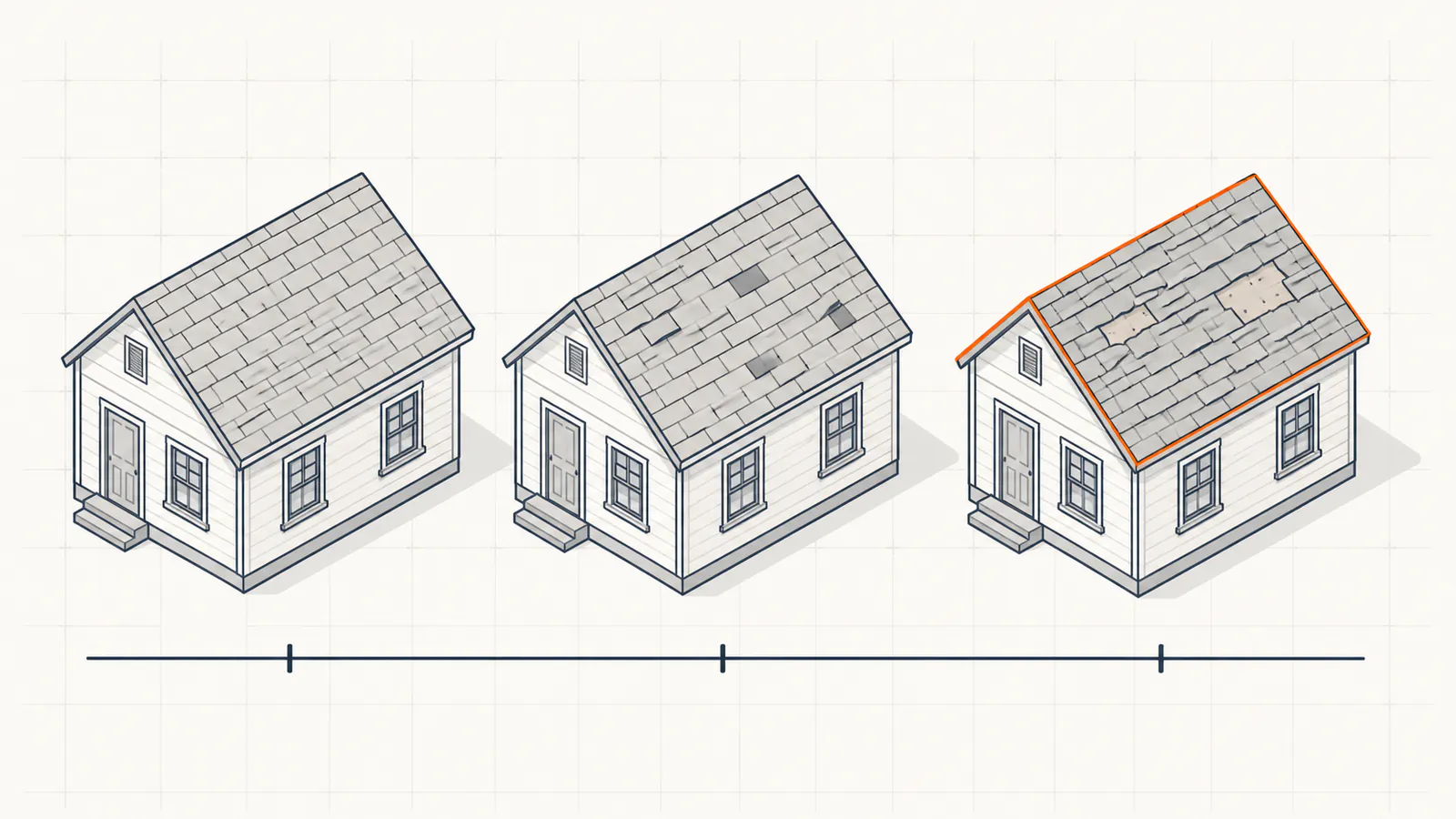
Architectural asphalt shingle roofs typically last 20 to 30 years and three-tab shingles 15 to 20. Metal commonly reaches 40 to 70 years, tile 40 to 50 or more, and slate can pass a century. Climate, installation quality, and attic ventilation regularly move a roof's real lifespan five years in either direction.
Key takeaways
- Architectural asphalt shingles typically last 20 to 30 years and three-tab shingles 15 to 20; metal, tile, and slate can double or triple that.
- Every roof runs three clocks at once (a material clock, a weather clock, and a workmanship clock), and the fastest clock decides when the roof is done.
- A "30-year shingle" is a warranty term, not a forecast; real-world service life for that grade of shingle is more often 20 to 25 years.
- Installation quality and attic ventilation are the two lifespan factors a homeowner controls, and both are largely set in a single week: the week the roof goes on.
- You can usually establish your roof's age in under an hour using closing documents, permit records, neighborhood history, and roof imagery, in that order.
- Age is a reason to look, not a verdict. Plenty of 25-year-old roofs are sound; the point of knowing your roof's age is to replace it on your schedule, not your insurer's.
Want this answered for your property? Request a free Roof Report, then review the findings and open questions by phone with RoofPredict.
How long does a roof last?
Here is the direct answer. An architectural asphalt shingle roof (the kind on most American homes built or reroofed in the last two decades) typically lasts 20 to 30 years. Three-tab asphalt shingles, the flatter and cheaper style common on 1990s and 2000s subdivisions, last about 15 to 20. Standing-seam metal commonly reaches 40 to 70 years. Concrete and clay tile last 40 to 50 years or more, but the waterproof underlayment beneath the tile usually needs replacement after 20 to 30. Natural slate can run 75 to 100 years or longer. Wood shakes and shingles give roughly 20 to 30 years with real maintenance. Flat and low-slope membranes span about 15 to 30 years depending on the product. These ranges reflect general industry guidance, including the National Association of Home Builders' 2007 Study of Life Expectancy of Home Components, and they describe well-installed roofs, not a promise for any specific house.
| Material | Typical service life | What usually ends it |
|---|---|---|
| Three-tab asphalt shingle | 15–20 years | Granule loss, curling, brittleness, hail bruising |
| Architectural asphalt shingle | 20–30 years | Granule loss, sealant failure, storm damage |
| Wood shake / shingle | 20–30 years | Splitting, rot, moss, fire-code retirement |
| Standing-seam metal | 40–70 years | Fastener, sealant, and coating failure, not the panel |
| Concrete or clay tile | 40–50+ years (underlayment 20–30) | Underlayment failure long before the tile fails |
| Natural slate | 75–100+ years | Fastener corrosion, flashing, finding qualified repair help |
| Flat / low-slope membrane (EPDM, TPO, PVC) | 15–30 years | Seam failure, ponding water, punctures |
Read the last column of that table carefully, because it holds the most useful idea on this page: a roof rarely dies as a whole. It dies at a component. On tile and metal roofs, the visible surface is almost never what fails first; the underlayment beneath the tile, or the fasteners, sealants, and flashings on a metal roof, give out decades earlier. That is why a 40-year-old tile roof can genuinely need major work while the tile itself looks perfect from the street, and why "how long does a roof last?" is really several questions wearing one coat.
A roof rarely dies as a whole. It dies at a component.
It also explains why honest answers come as ranges. Two identical shingles, from the same bundle, installed the same week, will age at different speeds in Phoenix and in Portland, and at different speeds on the south-facing and north-facing slopes of the same house. The rest of this guide unpacks what moves a roof toward the short or long end of its range: the material itself, the weather it lives under, and the quality of the hands that installed it. We will also walk through the fastest reliable ways to find out how old your current roof actually is, because for most homeowners that number is a mystery, and it does not have to be.
The short version
If you have asphalt shingles and do not know your roof's install date, plan on it being a 20-to-25-year asset and start paying real attention at year 15. Nothing about age alone means you need a new roof; it means you should stop guessing.
The Three Clocks that decide your roof's lifespan
Every published lifespan number is an average, and averages hide the mechanism. A more useful way to think about your specific roof is what we call the Three Clocks. Every roof runs three countdown clocks at the same time, each ticking at its own speed, and the roof is done when the first clock hits zero, not when all three do. Once you know which clock is running fastest on your house, most lifespan advice sorts itself out.
| Clock | What winds it down | Can you slow it? |
|---|---|---|
| The material clock | Slow chemical and physical aging that happens everywhere: UV exposure drying out asphalt binder, daily thermal expansion and contraction, granule shedding, coating wear. | Barely. You choose its speed once, when you pick the material and its grade. After that it ticks on its own. |
| The weather clock | Your region's specific punishments: hail strikes, wind uplift, ice dams, salt air, moss and algae in wet climates, extreme heat in dry ones. | Somewhat. You cannot move the house, but impact-rated or wind-rated products, good drainage, and prompt post-storm checks keep weather damage from compounding. |
| The workmanship clock | Installation quality, attic ventilation, flashing details, and maintenance. A bad nailing job or a baking attic quietly speeds up both other clocks. | Yes. This is the clock homeowners actually control, mostly during one week: the week the roof is installed. |
The Three Clocks explain most of the puzzles homeowners run into. Why did the neighbor's roof fail at 14 years while yours is fine at 22? Their weather clock probably took a hail strike yours missed, or their workmanship clock started fast because the installer skipped the starter course. Why does a "50-year" metal roof need work at 25? Its material clock is genuinely slow, but the workmanship clock (fastener gaskets, sealant at penetrations) runs on ordinary time. Why do inspectors care so much about attics? Because a poorly ventilated attic is a workmanship-clock defect that accelerates the material clock every summer afternoon.
The framework also tells you where your attention buys the most. If you live in hail country, the weather clock dominates, and the highest-value decision is an impact-rated shingle at the next replacement. If you live in a mild climate, the material clock dominates, and grade matters more than brand. And everywhere, in every climate and every material, the workmanship clock is the one that turns a 25-year roof into a 15-year roof without leaving a mark you can see from the driveway. We will come back to each clock by name throughout this guide.
Where roof lifespan numbers actually come from
It is worth knowing where the numbers on this page (and every page like it) originate, because the sources are fewer and older than most people assume. The figure quoted most often across the industry traces to a single document: the National Association of Home Builders' Study of Life Expectancy of Home Components, published in 2007. That study surveyed manufacturers, trade associations, and industry experts about how long building components last with normal maintenance. For roofing, it put asphalt shingles at about 20 years, wood shakes at about 30, metal roofing at roughly 40 to 80, and slate, copper, and clay or concrete tile at 50 years or more.
Three honest caveats apply. First, the study is a survey of expert opinion, not a tracking study that followed real roofs to failure; nobody has published a large public dataset like that. Second, it is now nearly two decades old, and shingle formulations, warranty structures, and severe-weather patterns have all shifted since 2007. Third, its numbers assume proper installation and maintenance, which is exactly the assumption that fails most often in the real world. The study remains the best-known anchor, and its ranges still line up reasonably well with what inspectors and insurers see. Treat it as a well-informed starting point, not a measurement.
The other sources of lifespan numbers each have their own bias, and knowing the bias tells you how to read the number. Manufacturer warranty terms are marketing instruments shaped by competition; when one brand went to "lifetime," the others followed, so they drift upward over time regardless of what shingles do on roofs. Insurance carriers run the numbers in the other direction: their actuarial experience with claims makes them conservative, which is why many carriers begin treating asphalt roofs differently somewhere between 15 and 20 years of age. Home inspectors and roofing contractors carry field experience that is vivid but local. An inspector in Denver and one in Seattle will give you sincerely different answers because they genuinely see different failure ages.
| Source | What its number really is | Bias to correct for |
|---|---|---|
| NAHB 2007 component study | Expert-opinion survey of expected life with normal maintenance | Optimistic about maintenance; nearly 20 years old |
| Manufacturer warranties | A materials-defect promise shaped by marketing competition | Reads high; excludes weather, wear, and workmanship |
| Insurance carrier age rules | Actuarial claims experience translated into underwriting | Reads low; built to limit the carrier's risk, not describe yours |
| Inspectors and roofers | Field experience with local failures | Accurate locally, misleading if imported from another climate |
| Historical imagery analysis | Observed replacement cycles across many real roofs | Shows when roofs were replaced, which mixes wear with choice and claims |
Our own contribution at RoofPredict is the last row: analyzing rooftops in roof imagery lets us watch when roofs actually get replaced, at neighborhood scale. What that view suggests, qualitatively, is that real-world replacement often arrives earlier than the material's physical limit, because storms, insurance pressure, and home sales retire roofs that might have had years left. The physical lifespan and the practical lifespan are different numbers, and for planning purposes the practical one usually matters more.
Why doesn't a 30-year shingle last 30 years?
A homeowner who buys a "30-year shingle" reasonably expects 30 years of roof. That is not what the number means, and the gap between what it says and what it means is probably the most common misunderstanding in residential roofing. The 30-year figure is a warranty term: a promise that the manufacturer will stand behind the material against manufacturing defects (a bad batch, delamination, premature coating failure) for that period. It is not a prediction that the roof system on your house will keep water out for 30 years, and the warranty document says so, at length, in the exclusions.
Those exclusions typically cover almost everything that actually damages roofs: hail, wind above a stated speed, foot traffic, ice damming, improper installation, and inadequate attic ventilation. Read that list against the Three Clocks and you will notice the pattern: the warranty covers the material clock and disclaims the weather clock and the workmanship clock entirely. Since the weather and workmanship clocks are the ones that usually finish first, most real roof failures fall outside warranty coverage by design. That is not a scandal; it is what a materials warranty is. The problem is only that the number on the wrapper reads like a lifespan.
Two more features of shingle warranties are worth understanding before you lean on one. First, proration: coverage that pays generously in the first years typically shrinks on a schedule, so a claim in year 18 of a 30-year warranty may be worth a small fraction of replacement cost, often materials only, with no labor or tear-off. Second, conditions: many warranties require product registration, installation by qualifying methods or contractors, and records you can produce years later. Over the past 15 years, most major manufacturers have also relabeled their architectural lines as "limited lifetime" warranties, which sounds like an upgrade but follows the same prorated, defect-only logic: "lifetime" describes the warranty's duration while you own the home, not the shingle's.
- Warranty term: how long the manufacturer stands behind the material against defects. A legal and marketing number.
- Service life: how long the installed roof system actually sheds water on your house, in your climate. The number this guide is about.
- Insurance-relevant age: how old your carrier believes the roof is, which drives your coverage terms and often forces the replacement decision first.
For planning, translate warranty grades into realistic service ranges: a "25-year" or "30-year" architectural shingle is a 20-to-25-year roof in most climates, and a "limited lifetime" architectural shingle is the same physical product with a longer warranty document. If a salesperson quotes the warranty as if it were a lifespan, that is not necessarily dishonest, but it is a good moment to ask what the proration schedule looks like in year 18.
The eight stressors that actually wear roofs out
Roofs almost never fail all at once, and they rarely fail for exotic reasons. The same short list of stressors shows up in inspection reports and post-storm engineering studies over and over. Ranked honestly for a typical US asphalt roof, the everyday agers come first: ultraviolet light and thermal cycling do the slow, guaranteed damage everywhere, while wind, hail, and moisture deliver the regional shocks. Then come the multipliers (installation quality, ventilation, and maintenance), which do not attack the roof directly but set how fast everything else lands.
| Stressor | How it ages a roof | Timescale | Your leverage |
|---|---|---|---|
| UV exposure | Sunlight slowly breaks down asphalt binder and surface coatings; granules exist mostly to block it. As granules shed, aging accelerates. | Constant, every daylight hour for decades | Low: material choice and granule quality decide this at purchase |
| Thermal cycling | Daily heating and cooling expands and contracts every component; over thousands of cycles, sealant bonds fatigue, fasteners back out, shingles crack. | Daily; worst where day–night swings are large | Low: ventilation reduces peak temperatures somewhat |
| Wind | Uplift peels at edges, rakes, and ridges; a single lifted shingle breaks the sealant bond and invites the next gust. Damage compounds. | Episodic; minutes of storm, years of consequence | Medium: wind-rated products, correct nailing, prompt repair |
| Hail | Impacts bruise the mat and knock granules loose, exposing asphalt to UV. Often invisible from the ground; shows up as accelerated aging afterward. | Episodic; regional lottery | Medium: Class 4 impact-rated shingles in hail country |
| Moisture and ice | Water finds every gap: ice dams push meltwater under shingles, ponding soaks low-slope seams, trapped humidity rots decking from below. | Seasonal; worst in freeze-thaw and wet climates | Medium: drainage, ice barriers, attic air-sealing |
| Installation quality | Mis-nailing, skipped starter courses, and bad flashing details create the weak points every other stressor exploits first. | Set permanently in one week | High: vet the contractor before, not after |
| Attic ventilation | A sealed, overheated attic cooks shingles from below in summer and feeds ice dams in winter. | Every summer afternoon and winter freeze | High: fixable on an existing roof, cheaply |
| Maintenance | Clogged gutters, debris-packed valleys, moss, and unrepaired small damage keep the roof wetter and weaker than it should be. | Ongoing; damage compounds when ignored | High: an hour or two per season |
The honest ranking depends on where you live, which is the weather clock's whole point. In most of the country, UV plus thermal cycling is the baseline that determines lifespan, and everything else moves the date around it. In hail alley, hail jumps to the top of the list: roofs there frequently retire by insurance claim before they wear out. On the hurricane coast, wind detailing at the edges matters more than anything printed on the shingle wrapper. In the snow belt, the ice-dam mechanism (house heat melting snow that refreezes at the cold eave and backs water up under the shingles) causes more interior damage than the shingles' age ever will.
Notice what is not high on the list: brand. Homeowners spend enormous energy comparing shingle brands, and inspectors will tell you the brand-to-brand differences within a grade are small compared with any single row of that table. The productive question is not "which brand lasts longest?" but "which of these eight stressors is fastest at my address, and what would slow it down?" The three multipliers at the bottom are where most homeowners find five cheap extra years.
How long do asphalt shingle roofs last?
Asphalt shingles cover most American homes (the Asphalt Roofing Manufacturers Association's trade estimates put them on roughly four out of five US houses), so their lifespan is the one that matters to the most people. The honest range is 15 to 30 years, and where a given roof lands depends first on which of the three shingle grades is on it. The grade matters more than the brand, and more than most homeowners are ever told.
| Grade | Typical service life | Typical installed cost | What you're buying |
|---|---|---|---|
| Three-tab | 15–20 years | $8,000–$13,000 | A single-layer shingle with cutouts that read as three tabs. Lightest, cheapest, lowest wind ratings. Increasingly a repair-match product rather than a first choice. |
| Architectural (dimensional / laminate) | 20–30 years | $10,000–$18,000 | Two bonded layers, heavier and thicker, better wind ratings, the default on most reroofs today. The grade most published "asphalt lifespan" numbers describe. |
| Luxury / designer | 25–30+ years | $15,000–$30,000 | Heavier still, styled to imitate slate or shake. More material and better ratings, but the premium often buys appearance as much as years. |
| Class 4 impact-rated (any style) | Grade's range, minus hail's usual discount | Roughly 10–25% over the same grade | Shingles that pass UL 2218 Class 4 (the test drops a 2-inch steel ball from 20 feet). In hail country, the point is fewer early retirements and, often, an insurance premium credit. |
How an asphalt shingle dies is worth one plain-English paragraph, because it explains almost every symptom on an aging roof. A shingle is a fiberglass mat soaked in asphalt and armored with ceramic-coated stone granules. The granules block UV; the asphalt stays flexible as long as its oils remain. Sun and heat slowly drive those oils out (the material clock at work), and the shingle stiffens. Brittle shingles shed granules faster, exposed asphalt ages faster still, and the curve bends downward at the end. That is why a roof can look fine at 18 years and rough at 21: asphalt aging is not linear, and the last few years are steeper than the first fifteen.
What ends asphalt roofs early, in rough order: hail bruising that never gets inspected, wind that breaks sealant bonds along edges and ridges, attic heat that accelerates the oil loss, and, quietly and everywhere, nailing mistakes from the original install that let individual shingles creep loose years later. Algae staining, common across the humid Southeast, looks alarming but is mostly cosmetic. Moss is different, because it holds water against the shingle and pries at the edges as it grows. If you are choosing shingles for a replacement, the two upgrades with the clearest lifespan payoff are Class 4 impact resistance in hail states and, in every state, spending the difference on a better installer rather than a fancier shingle.
The 15-year habit
An asphalt roof needs almost nothing from you for its first decade beyond clean gutters. From year 15 on, walk the perimeter each spring and after major storms, look at the ceiling below the roof twice a year, and get a professional look every few years. The failure mode you are preventing is not sudden collapse — it is a slow leak you find a year late.
How long do metal roofs last?
Metal is where lifespan marketing gets furthest ahead of the fine print, so the ranges need unpacking. A standing-seam metal roof (panels joined by raised, interlocking seams, fastened with hidden clips) commonly lasts 40 to 70 years. An exposed-fastener metal roof, the corrugated screw-down style common on barns, cabins, and budget installs, is a different product with a different clock: realistically 20 to 30 years, because every one of its thousands of gasketed screws is a small waterproofing job that ages in the sun.
| System | Typical service life | Typical installed cost | The catch |
|---|---|---|---|
| Standing-seam (concealed fastener) | 40–70 years | $20,000–$40,000+ | Panels outlast their accessories. Sealants, flashings, and clips need attention on ordinary 15-to-20-year schedules. |
| Exposed-fastener (screw-down) | 20–30 years | $12,000–$20,000 | Gasketed screws loosen with thermal cycling and their washers weather. Plan on re-fastening or replacing screws mid-life. |
| Stone-coated steel | 30–50 years | $18,000–$30,000 | Steel panels dressed with granules to mimic shingles or tile. Performance tracks the coating and the installer's familiarity with the system. |
What actually ends a metal roof is rarely the metal. The panel steel or aluminum, protected by a galvanized or Galvalume base layer and a factory paint finish, can genuinely run half a century; premium PVDF paint finishes commonly carry multi-decade fade and chalk warranties. The endings come from the workmanship clock: sealant at penetrations drying out, flashing details at chimneys and valleys, fasteners backing out with thousands of expansion cycles, and scratches or salt exposure starting corrosion at cut edges. Coastal salt air deserves special mention. Near the ocean, aluminum outlasts steel, and manufacturers' warranties often say so in the exclusions.
Two practical cautions for the weather clock. Hail rarely breaches a metal roof, but it dents one, and many insurance policies carry cosmetic-damage exclusions for metal, which means a hailstorm can leave your roof functionally fine, visibly pocked, and not covered for its appearance. And in snow country, metal sheds snow suddenly rather than gradually; snow guards over doorways are a small line item at install time and a headache to retrofit. Neither caution argues against metal, which measured per year of service is one of the best buys in roofing. They argue for reading your policy and your quote before, not after.
How long do tile roofs last?
Tile is the clearest illustration in all of roofing that a roof is a system, not a surface. Concrete and clay tiles themselves last 40 to 50 years or more. Clay, especially, can go far longer, and there are clay roofs in the Southwest and in Europe older than the United States. But the tile is not the waterproofing. The actual water barrier is the underlayment: sheets of asphalt-saturated felt or synthetic membrane fastened to the deck beneath the tiles. That underlayment typically lasts 20 to 30 years, and it, not the tile, sets the maintenance schedule for the whole roof.
This is the Three Clocks framework in its purest form: the tile's material clock runs slow, but the system inherits the underlayment's faster clock. The practical consequence is a procedure most homeowners have never heard of until a roofer proposes it: the lift-and-relay (also called a relift or R&R). Crews remove the tiles carefully (breakage is the cost driver), replace the underlayment, flashings, and battens, and reinstall the original tiles with a percentage of new ones to cover breakage. It costs meaningfully less than a full tile replacement and resets the roof's real clock. A tile roof approaching 25 years old with original underlayment is due for an underlayment conversation, however good the tile looks from the street.
- Concrete tile: typical 40–50+ year tile life; heavier and cheaper than clay; surface color can fade and the tiles can grow more porous with decades of weathering.
- Clay tile: 50+ years and often much more; holds color permanently; costs more and is more brittle underfoot, which makes maintenance foot traffic the main breakage risk.
- Underlayment beneath either: 20–30 years for traditional felts, with modern synthetic and self-adhered membranes marketed to extend that; treat those claims as warranty numbers until they have decades behind them.
Three cautions complete the picture. Weight: tile runs several times the weight of asphalt, so putting tile on a house framed for shingles requires an engineering check, not a salesperson's assurance. Walking: more tiles are broken by people (satellite installers, chimney sweeps, pressure washers) than by weather; keep foot traffic off, and when trades must go up, ask how they will walk it. And freeze-thaw: in cold climates, only tiles rated for freeze-thaw cycling belong on the roof, which is one reason tile stays mostly a Sun Belt material. Within its climate, though, tile paired with disciplined underlayment renewal is one of the few roofs a homeowner can plausibly buy once.
Averages only get you so far. A Roof Report puts your property on the timeline with an estimated age range, the evidence behind it, and the questions that could narrow it.
How long do slate, wood, and synthetic roofs last?
Natural slate is the longevity champion of residential roofing: 75 to 100 years is a normal expectation for good slate, and the best hard slates (Vermont and Virginia unfading varieties are the classic examples) routinely pass a century. Softer slates from some historic Pennsylvania quarries age out sooner, which is why two slate houses on the same street can be a half-century apart in remaining life. As with tile, the surface outlives the system: what fails on a slate roof is usually the fasteners (century-old iron nails rust through and slates begin to slip) and the flashings, which may need renewal two or three times across the slate's life.
The honest caveats about slate are practical rather than physical. It is heavy, so the structure must be built or verified for it. It is expensive: cost surveys put full slate installs far above every other residential material. And the craft is scarce. In much of the country, finding a roofer who can properly repair slate (rather than smear roofing cement across it, which slate specialists regard as vandalism) is the hardest part of owning one. If you have inherited a slate roof, the single best move is finding a slate-literate contractor before you need one, and refusing to let anyone walk on it in the meantime.
Wood shakes and shingles, cedar mostly, sit at the opposite end of the maintenance spectrum: roughly 20 to 30 years, and the range is earned, not given. Wood is the one common roofing material that actively responds to care. Kept clear of debris and moss, allowed to dry between rains, and treated periodically, cedar can reach the top of its range; neglected under tree cover in a wet climate, it can rot out in 15. Wood's other clock is regulatory. In wildfire-prone regions, untreated wood roofing increasingly cannot be installed or insured, and some jurisdictions have effectively retired it. Many "wood" roofs sold today are actually fire-rated pressure-treated shakes or look-alike alternatives.
Synthetic and composite roofing, meaning polymer or rubber products molded to imitate slate or shake, is the newest category, and its lifespan claims deserve gentle skepticism of a specific kind. Manufacturers commonly rate these products for 40 to 50 years, and their lab testing is real; what does not yet exist is a large population of 40-year-old synthetic roofs, because the products have not been on the market that long. The honest statement is that synthetics are engineered to outlast asphalt, priced between asphalt and the naturals they imitate, and still accumulating the only evidence that settles lifespan arguments: decades on real houses.
How long do flat and low-slope roofs last?
Most homeowners meet a flat roof somewhere: over an addition, a porch, a garage, a dormer, or the whole house if it is a mid-century modern or a rowhouse. Low-slope roofing is a different discipline from shingles. Water leaves slowly instead of immediately, so the covering must be genuinely waterproof rather than merely water-shedding, and its lifespans run 15 to 30 years across the common membranes.
| Membrane | Typical service life | How it usually fails |
|---|---|---|
| EPDM (rubber) | 15–25 years | Seam adhesive failure, shrinkage pulling at edges, punctures |
| TPO | 15–25 years | Seam and flashing failures; product quality varies more than most categories |
| PVC | 20–30 years | Long-lived but costlier; plasticizer loss and seams at the end |
| Modified bitumen | 15–25 years | Surface erosion, seam failure, blistering |
| Built-up (tar and gravel) | 20–30 years | Cracking and alligatoring as the asphalt oxidizes; mostly a legacy system on homes |
Two factors dominate low-slope lifespan, and neither is the membrane brand. The first is ponding: water that stays on the roof more than a day or two after rain. Standing water magnifies UV attack, strains seams, and finds pinholes that shed water would never notice; chronic ponding can halve a membrane's life, and fixing the drainage (added drains, tapered insulation, cleared scuppers) is usually worth more than upgrading the membrane. The second is seam workmanship. A low-slope roof is only as good as its field seams and flashing terminations, which is the workmanship clock at its most literal.
If your house has a small low-slope section attached to a shingled main roof, give it disproportionate attention: those transitions, where the shingle roof drains onto the flat section, are classic leak points, and the flat section will almost certainly need replacement before the shingles above it. Budget for it as a separate, shorter-lived asset rather than assuming it renews with the main roof.
The rest of the system: component lifespans
Homeowners say "roof" and mean the shingles, but the shingles are one component among a dozen, each running its own clock, and several of those clocks are shorter than the covering's. This is why a roof that "isn't old yet" can still leak, and why a leak on a young roof is usually good news in disguise: odds are a component failed, not the roof. Knowing the component lifespans below protects you in both directions, from ignoring a fixable leak and from a salesperson turning a $400 boot repair into a $15,000 replacement.
| Component | Commonly cited service life | What homeowners should know |
|---|---|---|
| Pipe boots (plumbing vent flashings) | 10–15 years | The rubber collar around plumbing vents cracks in the sun, and it is the single most common source of the first leak on an otherwise healthy roof. Cheap to replace. |
| Exposed sealants and caulk | 5–15 years | The shortest-lived material on the roof. Anywhere a previous repair relied on caulk alone is a future leak with a schedule. |
| Underlayment (beneath the shingles) | Ages with the covering; 20–30 years under tile | The backup water barrier. Under shingles it is replaced at reroof time automatically; under tile it is the real lifespan of the roof (see the tile chapter). |
| Metal flashing (walls, chimneys, valleys) | Decades, often multiple shingle cycles | The metal outlasts the shingles, which tempts roofers to reuse it. Reused flashing at a reroof is a classic corner cut; the bends and nail holes rarely survive intact. |
| Ridge and attic vents | 20–30 years | Plastic vents grow brittle in UV; metal ones dent and rust. Storm-bent vents are commonly missed damage after hail. |
| Gutters and downspouts | 20–30+ years for aluminum | Not waterproofing, but the drainage the roof depends on. Sagging or overflowing gutters age the eaves and feed ice dams. |
| Skylights | 20–30 years | The unit's seals and flashing kit age on their own clock. Best practice is replacing skylights at reroof time so the clocks align. |
| Roof decking (sheathing) | Indefinite while dry | The plywood or OSB under everything lasts as long as it stays dry, and rots quickly where it doesn't. Decking condition is discovered, not scheduled: it shows at tear-off. |
Two planning consequences fall out of that table. First, a roof in its teens deserves a components check even if the shingles look fine. Boots, sealants, and vents from the original install are reaching their ends, and an hour of minor service prevents the interior damage that makes small failures expensive. Second, at replacement time, the components are where bids quietly differ: two quotes for "the same shingle" can hide very different answers about new flashing versus reused, upgraded underlayment, new boots and vents, and decking repair pricing. The lowest bid often economizes exactly here, on the parts that determine whether the new covering reaches its rated life.
The rule that ties it together: water damage compounds, components don't wait for the covering, and every component failure caught early is a repair while every one caught late is a renovation. When a leak appears, the question to ask, before anyone says the word "replacement," is which component failed, and what the rest of the system's clocks say.
Comparing materials on cost per year
Sticker price is the wrong number to compare roofing materials on, because the products deliver wildly different amounts of time; the fair comparison divides realistic installed cost by realistic service life and ranks materials in dollars per year of dry house. That arithmetic, which usually puts architectural asphalt and standing-seam metal at the head of the pack and turns some "budget" options into the expensive ones, is worked through material by material as the Cost-Per-Year Test in our 2026 roof replacement cost guide.
How does your climate change how long your roof lasts?
The same shingle, installed identically, ages at different speeds in Phoenix, Minneapolis, and Tampa: the weather clock is set by your address. Nationally published lifespans are averages across all of it, which is why they miss high and low locally. Here is the qualitative map; for the region-by-region depth (hail frequencies, hurricane detailing, ice-dam mechanics, and what each region's roofs actually die of) see our regional roof lifespan atlas, which exists so this guide doesn't have to compress it.
| Region | Dominant stressor | Practical effect on lifespan |
|---|---|---|
| Hail alley (TX, OK, KS, NE, CO front range) | Repeated hail | Roofs frequently retire by insurance claim before wearing out; impact-rated shingles are the regional upgrade with the clearest payoff. |
| Hurricane and high-wind coast (Gulf, Southeast Atlantic) | Wind uplift and driven rain | Edge and fastening details decide survival; the FORTIFIED Roof standard's sealed deck and enhanced edges exist for exactly this. |
| Snow and ice-dam north (Upper Midwest, Northeast) | Freeze-thaw and ice dams | Cold itself is gentle on shingles; the damage comes from house heat melting snow that refreezes at the eaves and pushes water backward under the roof. |
| Desert Southwest (AZ, NV, inland CA, West TX) | UV and heat | Asphalt ages out fastest here, often years early, which is why tile dominates the region's rooflines. |
| Humid Southeast | Moisture, algae, and heat | Algae streaking is cosmetic; persistent damp and shaded moss are not. Algae-resistant shingles and airflow matter most. |
| Pacific Northwest and mild-marine West | Moss and debris under tree cover | The gentlest material-clock region in the country; roofs kept clear of moss commonly reach the top of their rated range. |
Climate also operates at a smaller scale than region, and this is worth internalizing before you compare notes with anyone. South- and west-facing slopes take the most sun and age fastest; north-facing slopes stay damp and grow the moss. A roof under mature trees lives in its own micro-climate of shade, debris, and drip. Two houses a mile apart can sit on opposite sides of a historic hail swath. Storm history is street-level, not regional, which is why the NOAA Storm Events Database and roof imagery matter more than any regional generalization when you are assessing one specific address.
The takeaway for lifespan planning: localize every number in this guide before you rely on it. A 20-to-30-year architectural shingle is a 15-to-22-year proposition in the high desert and a 25-to-30-year one in coastal Oregon. Roof-age rules of thumb borrowed from relatives in other states (or from national averages, including ours) are starting points. Your climate, your slope orientations, and your street's storm history finish the sentence.
Does installation quality matter more than the material?
Ask roofers and inspectors this question and you will hear a striking consensus: yes. A mid-grade shingle installed excellently routinely outlasts a premium shingle installed carelessly. You will also hear a statistic, "half of all roofs fail early because of bad workmanship," that deserves flagging, because as far as anyone can trace, it is folklore. The figure circulates through industry marketing and contractor sales pitches with no identifiable study behind it. We are not going to repeat it as fact, and you should discount anyone who does.
What is well supported is the direction, if not the percentage. Post-storm engineering investigations (the Insurance Institute for Business & Home Safety's wind research programs are the best-known) consistently find installation details at the center of early failures: shingles nailed above the manufacturer's nailing zone, too few fasteners, unbonded sealant strips, missing starter courses, and improvised flashing. Manufacturer warranty denials cluster around the same defects. The honest statement is that workmanship is one of the largest controllable factors in roof lifespan, that its failures are concentrated in a short list of known details, and that nobody has credibly measured its share of early failures.
Why does one week of labor carry so much weight? Because the workmanship clock is set once and then runs untouched for decades. Every other component of your roof can be maintained; the nailing pattern cannot. A nail driven half an inch too high misses the reinforced nailing strip and the shingle below it: the shingle is now held by less than its design intends, and the defect sits invisible under the next course until a windstorm fifteen years later finds it. Multiply by the thousands of nails in a roof and you see why crews' habits matter more than brochures.
- Nailing: correct count (more in high-wind zones) placed in the manufacturer's nailing zone, the single most consequential detail on the roof.
- Starter course: purpose-made starter strips at eaves and rakes, not cut-up field shingles, so the first row's sealant bond actually exists.
- Flashing: new metal at walls, chimneys, and valleys rather than reused old flashing buried under new shingles; reused flashing is the classic corner cut.
- Ice barrier: self-adhered membrane at the eaves in cold climates, required by code in most snow regions and worth confirming on the quote.
- Ventilation: intake at the soffits matched to exhaust at the ridge, calculated rather than guessed; a roofer who doesn't mention ventilation is telling you something.
- Manufacturer specs: shingles installed per the wrapper's instructions, which is also what keeps the wind warranty enforceable.
The practical move is to spend your effort where the leverage is: vet the installer at least as hard as the shingle. Ask how many nails per shingle and where; ask what happens at the valleys and who supplies new flashing; ask for the ventilation calculation; ask whether the crew is the company's or a subcontractor's, and who inspects the work. A contractor who answers those fluently is showing you their workmanship clock. One who redirects to warranty years is showing you a brochure. Our guide to choosing a roofing contractor turns this into a full checklist with the pressure tactics to walk away from.
Does a second layer of shingles shorten a roof's life?
Generally, yes. An overlay (also called a nail-over, re-cover, or layover) installs new shingles directly over the old ones instead of tearing off first. Building codes commonly allow it up to a total of two layers, and it saves real money up front by skipping tear-off labor and disposal. The trade is paid back in years: roofers and manufacturers widely agree that a second layer ages faster than the same shingle on a clean deck, though, in keeping with this guide's habit, no one has published a rigorous measurement of how much faster. Treat any precise percentage you hear as sales math.
The mechanisms behind the shorter life are concrete. The new shingles run hotter, because the old layer underneath holds heat against them (a material-clock accelerant; the ventilation chapter explains why). They lie less flat, telegraphing every curl and bump of the old roof, which stresses the new shingles and can compromise sealant bonding. Nails must reach the deck through an extra layer, so fastener holding power drops just as nailing precision matters more. And the tear-off inspection never happens: whatever the old roof was hiding (soft decking, rot around a chimney, an old leak's damage) gets sealed in rather than fixed. An overlay is a faster-aging roof installed over an unexamined one.
- Warranty: many manufacturers reduce or restrict coverage on overlays; ask for the specific warranty terms in writing before agreeing to one.
- Insurance: some carriers surcharge, restrict, or decline roofs with multiple layers, and a future claim adjustment gets more complicated with two layers to price.
- The next roof costs more: when the overlay ages out, the tear-off you skipped comes due doubled, with two layers of removal and disposal in one bill.
- Weight: a second layer of asphalt adds meaningful load; fine for most framing, but it is the kind of question that deserves an answer rather than an assumption.
Is an overlay ever the right call? Occasionally. If the existing single layer lies dead flat, the deck is known to be sound, the climate is mild, and the budget genuinely will not stretch to a tear-off, or the owner expects to sell within a few years, an overlay buys functional roof for less money, and that can be the rational choice. What it should never be is a default or a surprise: an honest bid says "overlay" in large print and prices the tear-off alternative next to it. If you discover mid-project that your roofer planned to nail over the old shingles, that is a contractor conversation, not a roofing one.
One diagnostic tip for the Roof Age Paper Trail: if your roof already has two layers, that fact itself is evidence. It usually means the visible shingles are younger than the roof problem underneath them, and it resets what "roof age" even means for insurance and planning. Carriers and buyers will treat the system, reasonably, as older than its top layer.
Attic heat and ventilation: the lifespan factor under the deck
If the workmanship clock has a single loudest tick, it is the attic. Your shingles are rated for weather arriving from above; what shortens their lives as reliably as any storm is heat and moisture attacking from below. This is also the rare lifespan factor you can fix on an existing roof for hundreds of dollars rather than thousands, which is why it earns its own chapter.
150°F
Temperature an unventilated attic can reach on a hot summer day
U.S. Department of Energy, Energy Saver
The summer mechanism is simple cooking. The Department of Energy's Energy Saver guidance notes attics can reach around 150°F on hot days. A shingle above a sealed 150°F attic runs hotter than the same shingle above a ventilated one, and heat is the accelerant for everything that ages asphalt: the binder's oils leave faster, thermal-cycling swings widen, and sealant bonds fatigue sooner. Roofers see the result as a roof that ages years ahead of its neighbors, often with a telltale pattern: worst over the living space, mildest over the ventilated garage.
The winter mechanism is the ice dam, and it drowns more ceilings than old shingles do. House heat leaking into the attic warms the roof deck; snow on the warm deck melts; the meltwater runs down to the eave (which overhangs cold air and stays frozen) and refreezes into a growing ridge of ice. Water pooling behind that ridge has nowhere to go but backward, up under the shingles, into the walls. The fix is counterintuitive to most homeowners: a cold roof is a healthy roof in winter. Air-seal the ceiling below the attic, insulate it well, and ventilate the attic so the deck stays near outdoor temperature and the snow on it never melts from below.
Balanced ventilation is the goal: intake low at the soffits, exhaust high at the ridge, in roughly equal measure so air actually flows. A common code rule of thumb sizes total vent area at 1/300th of the attic floor area (1/150th without a vapor barrier), split between intake and exhaust, but the arithmetic matters less than the balance: ridge vents without open soffit intake move little air, and the classic silent failure is soffit vents blocked by attic insulation stuffed into the eaves. Warning signs you can check yourself in an hour: an attic that feels like an oven by mid-morning, rusty nail tips or frost on the underside of the deck in winter (condensation), ice dams every snowy year, and insulation jammed tight where the roof meets the walls. Any of them is worth a conversation well before it is worth a new roof.
How can you find out how old your roof is?
Most homeowners cannot name their roof's age, especially if they were not the ones who bought the roof, and it is the single most useful fact in this entire guide, because every planning decision hangs on it. The good news: for most houses the answer is recoverable in under an hour. We call the sequence the Roof Age Paper Trail, and it runs from the cheapest evidence to the most technical: closing documents, then permits, then the neighborhood, then roof imagery. Work it in order and stop when you have an answer you can defend.
Step one: your closing documents. Somewhere in the folder from when you bought the house (increasingly a PDF from your agent or title company) are a home inspection report and a seller's disclosure. Inspectors routinely estimate roof age and note visible condition ("architectural shingles, estimated 8–10 years, moderate granule loss"), and disclosure forms in most states ask sellers directly about roof age and repairs. An appraisal may mention it too. This is ten minutes of searching a PDF for the word "roof," and for recently purchased homes it often ends the hunt. Caveat: a disclosure that says "unknown" is common and honest, and an inspector's estimate is an estimate. Treat it as evidence, not gospel.
Step two: permit records, the strongest evidence short of an invoice. Roof replacements require a building permit in most US jurisdictions, and many counties and cities now run searchable online permit portals; search your address plus "building permit search" and your county's name. A reroof permit typically shows the issue date, the contractor, and sometimes the material, and a finalized permit with a passed inspection is as close to proof as roof age gets. Caveats: portals often only go back to the 1990s or 2000s digitization cutoff; some rural jurisdictions did not require reroof permits historically; and a missing permit can mean unpermitted work rather than no work. If the portal is unhelpful, a phone call to the building department with your address often shakes loose older paper records.
Step three: the neighborhood, which works startlingly well in tract-built subdivisions. If your street went up in one build cycle (check your own home's build year against the neighbors' on the county assessor's site), the original roofs all started aging together, and they tend to be replaced in a visible wave 15 to 25 years later, often accelerating after a shared hailstorm. Long-tenured neighbors remember the year the street was full of roofing crews, and whether your house joined the wave. An HOA, if you have one, may hold records of exactly this. The build year itself is your floor: no roof is older than the house under it.
Step four: historical roof imagery, the method that works when paper fails. Roofs are photographed from above constantly, and a replacement is visible: the surface changes color or texture between one image pass and the next, because new shingles read darker and more uniform than weathered ones. Free historical imagery tools let a patient homeowner scrub through a decade or two of passes and bracket the change to a window of a few years. This is the method RoofPredict automates, reading those surface changes across years of imagery at scale, and it is why our estimates arrive as ranges rather than dates; our methodology page explains what the imagery can and cannot resolve.
| Evidence | What it establishes | Strength |
|---|---|---|
| Contractor invoice or warranty registration | Exact replacement date and material | Definitive |
| Finalized reroof permit | Replacement year, contractor, often material | Near-definitive |
| Home inspection report / seller disclosure | A professional or sworn estimate at a known date | Good, but an estimate |
| Neighborhood replacement wave + build year | A plausible window, plus a hard floor | Circumstantial but useful |
| Roof imagery change | A replacement window of a few years | Good range; no exact date |
| Eyeballing the shingles from the street | Very little, since weathering varies too much | Weak; use only to sanity-check |
Why a range, not a date
Unless someone produces a permit or an invoice, every roof age is an estimate, and a trustworthy one sounds like "most likely 17 to 21 years," not "19 years." Be politely skeptical of anyone (a roofer at your door especially) who states your roof's exact age without producing a record.
Whatever the trail yields, write it down: the age, the evidence, and the date you established it. Keep it with your insurance papers. You will want it at every renewal, every claim, every sale negotiation, and every contractor conversation for as long as you own the house. Other guides on this site link here for a reason: this hour of homework is the foundation the rest of your roof decisions stand on.
Maintenance that actually buys years
You can make a roof last longer, not by heroics on the shingles but by controlling water, debris, heat, and traffic around them. None of the items below adds cost beyond attention and an occasional service call, and together they are the difference between a roof that reaches the top of its range and one that quits early. Think of maintenance as defending the material clock: you cannot slow the chemistry, but you can stop subsidizing it.
| When | What to do | Why it buys years |
|---|---|---|
| Every spring | Walk the perimeter: look for slipped, cracked, or curling shingles, sagging gutters, and dark streaks. Glance at ceilings and the attic for stains. | Small failures found in year one are repairs; found in year three they are decking and drywall. |
| Every fall | Clean gutters and downspouts; clear valleys and behind chimneys of leaves and needles; trim branches back from the roof. | Debris holds moisture against shingles and dams water; overhanging limbs drop debris, shade moss into existence, and abrade shingles in wind. |
| After every major storm | Ground-level check for missing or lifted shingles, granule piles at downspouts, and dented vents or flashing. In hail country, note the date even if nothing looks wrong. | Wind and hail damage compounds quietly, and insurance claims run on deadlines measured from the storm date. |
| Every 2–3 years, and at year 10–15 regardless | A professional inspection (ideally by an inspector with no replacement bid at stake) and a written condition report. | A documented baseline turns every future decision (repair, claim, sale, renewal) into an evidence conversation instead of a guess. |
| As needed | Treat moss early (zinc or manufacturer-approved cleaners, never a pressure washer); fix flashing and sealant promptly; keep trades' foot traffic off the shingles. | Moss pries shingles apart as it grows; pressure washing strips the granules that are the shingle's armor; every footstep on a hot or brittle roof costs granules. |
Two upgrades are worth evaluating on an existing roof. Ventilation retrofits (opening soffit intake, adding a ridge vent, unblocking insulation-stuffed eaves) attack the biggest below-deck ager directly and typically cost a small fraction of a reroof. And in hail or wind country, ask your insurer what documentation or hardening earns credits now, rather than discovering the answer at replacement time. The FORTIFIED Roof program's incremental steps, for instance, matter at reroof time but reward planning years ahead.
A word on shingle "rejuvenation" sprays: oil- or bio-based treatments marketed to restore flexibility to aging shingles and extend life five years or more per application. The honest summary as of 2026: the chemistry is plausible, the marketing is ahead of the independent evidence, and the treatments are typically pitched at exactly the roofs (15-plus years old) where the money might be better saved toward replacement. Some insurers and roofing manufacturers are openly skeptical; a few state programs have piloted them. If you consider one, get the claim in writing, check whether it affects your shingle warranty or insurance, and treat it as a bet, not a maintenance item.
What does not help, despite persistent salesmanship: preventive full-roof sealant coatings on shingles (they can void warranties and trap moisture), pressure washing (it removes the granule armor along with the algae), and replacing a functioning roof early out of pure age anxiety. The goal of maintenance is to collect every year the material was designed to give you, and to know, rather than guess, when those years are ending.
When does roof age start to matter for insurance?
For most homeowners, the first real consequence of an aging roof arrives in the mail as a letter from their insurer, not as a leak. Carriers, particularly in storm-exposed states, have tightened roof underwriting in recent years, and the practices are age-driven, which means they arrive on a schedule whether or not your roof has a single thing wrong with it. This is why the Roof Age Paper Trail is worth the hour even on a roof that is not leaking: the insurance clock reads your roof's age, not its condition.
The insurance clock reads your roof's age, not its condition.
- Switching older roofs from replacement cost value (RCV) to actual cash value (ACV), meaning claim payouts are depreciated by the roof's age; the difference can be most of a roof's cost on a 20-year-old shingle roof.
- Adding a separate wind and hail deductible, often a percentage of the dwelling coverage rather than a flat dollar amount, so the out-of-pocket on a roof claim quietly becomes thousands.
- Requiring an inspection or roof certification at renewal once the roof passes a stated age.
- Declining to write or renew a policy past a threshold, commonly discussed in the 15-to-20-year range for asphalt, though it varies widely by carrier and state.
None of this is universal, and your policy documents are the authority on your own terms. But the planning implication is the same everywhere: your roof's insurance-relevant lifespan is often shorter than its physical one, and the age at which carriers lose enthusiasm (roughly year 15 for asphalt) is a better planning milestone than the age at which shingles fail. Documented evidence moves this needle more than people expect. A recent inspection report, permit records, or an imagery-based age estimate can correct a carrier's assumed roof age, which is sometimes wrong in your favor. Our guide to roof age and home insurance covers the ACV arithmetic, certification inspections, and what to do about a non-renewal notice.
A roof's life, year by year
Lifespan ranges describe the whole arc; owning a roof happens one year at a time. Here is the arc of a typical architectural asphalt roof translated into phases: what is normal, what deserves attention, and what each stretch of years asks of you. Three-tab roofs run the same arc compressed by about five years; metal and tile stretch it out and swap in their own component schedules.
| Phase | What's normal | What it asks of you |
|---|---|---|
| Years 0–2: settling in | Loose granules washing into gutters ("new-roof shed") are normal. Sealant strips finish bonding through the first hot season. Installation defects, if any, tend to announce themselves early. | Keep every document: contract, permit, warranty registration. Look hard at ceilings and the attic after the first heavy rains; year-one problems are workmanship claims, and they are time-sensitive. |
| Years 3–12: the quiet middle | Almost nothing. Gradual, even weathering. The roof needs less from you than any other part of the house. | Seasonal maintenance only: gutters, debris, a glance after storms. In hail country, log storm dates even when nothing looks wrong. |
| Years 13–17: the watch begins | First components age out: pipe boots crack, sealants dry, vents grow brittle. Insurance treatment may begin to shift. Aging becomes visible on close inspection, not from the street. | A professional baseline inspection with a written report. Fix the small component failures. Read your policy's roof language. Start the replacement fund. |
| Years 18–24: visible age | Granule thinning, edges of curl on the sun-beaten slopes, the roof's aging curve steepening. For three-tab, this phase is end-stage; architectural grades vary widely here by climate and attic. | Annual attention. Independent inspection every year or two, documented. Solicit unhurried replacement bids so a storm never forces a rushed choice. |
| Years 25+: collected time | Every year past 25 is a year the material clock, weather clock, and workmanship clock all cooperated. Some roofs get five more; few get ten. | Replace on your terms, on your calendar, in a normal season. Replacing at 26 by choice beats replacing at 27 in November, after a leak. |
The financial translation of that table is a sinking fund, and it is the single calmest way to own an aging roof. From the watch phase onward, set aside roughly a tenth of a replacement's cost each year: a few hundred dollars a month for most homes, scaled to the unhurried bids you gathered once age became visible. A homeowner who starts at year 15 arrives at year 25 with the roof fully funded, immune to financing pressure and to the storm-chaser's "sign today for this price" pitch. The roof was always going to cost that money; the fund just decides whether it costs it on your schedule.
The phases also explain a pattern worth naming: most roof anxiety arrives in the quiet middle, triggered by a door-knocker or a neighbor's replacement, when the roof needs nothing; most real deterioration begins in the watch phase, precisely when homeowners have stopped thinking about it because nothing happened for a decade. Calibrate to the calendar, not to the door-knocker. The phases are predictable, and that predictability is the whole advantage.
How do you know when your roof's time is actually up?
After twenty chapters about lifespan, the ending should be said plainly: roofs are replaced on condition, not on birthdays. Age tells you when to start looking and how skeptically to look. It does not tell you what you will find. The end of a roof's life announces itself through a consistent set of signals, and almost all of them can be checked without a ladder: widespread granule loss with shingle mat showing through, shingles that crack rather than flex, curling and cupping across whole slopes rather than isolated spots, repeated leaks in different places (one leak is a repair; a migration is a verdict), and daylight or moisture in the attic. The signs you need a new roof walks through each one with photos of what to look for.
When some of those signals appear, the question becomes repair or replace, and age is the tiebreaker. The same cracked flashing is an easy repair on a 10-year-old roof and a harder call on a 22-year-old one, because every dollar into a roof near the end of its material clock buys fewer years of service. A useful rule of thumb from the repair-versus-replace decision: compare the repair's cost against the roof's remaining life, not against the cost of replacement; our repair-or-replace guide turns that into arithmetic you can do at the kitchen table.
| Roof age (asphalt) | Reasonable posture |
|---|---|
| Under 10 years | Keep gutters clear, glance at ceilings after big storms, and keep the install paperwork somewhere findable. Nothing else is urgent. |
| 10–15 years | Get one baseline inspection so you know the starting condition, and confirm the attic ventilation is adequate (the cheapest life extension available). Establish the roof's age now, while the paper trail is short. |
| 15–20 years | Know condition, not just age. Read your policy's roof language before you need it. Start a replacement fund even if the roof is fine; the money is needed within ten years no matter what. |
| 20–25 years | Annual attention. Have it inspected by someone with no replacement bid at stake and get the condition in writing. Solicit replacement bids casually in a normal season, before you are choosing a roofer in a hurry after a storm. |
| 25+ years | You are on collected time: enjoy it, but replace on your terms. Watch for the end-of-life signals, keep documentation current for your insurer, and treat any major storm as an inspection trigger. |
Return, one last time, to the Three Clocks. Your roof's material clock was set the day it was installed; its weather clock is set by your address; its workmanship clock was set by a crew you may never have met. You cannot rewind any of them, but you can read them. Find the roof's age, check which clock runs fastest where you live, and let the maintenance calendar collect the years the roof has left. A 22-year-old roof that is sound is still a roof; a homeowner who knows it is 22 has traded surprise for a plan, and that is the entire point of knowing how long a roof lasts.
Frequently asked questions
- How long does an asphalt shingle roof last?
- Typically 15 to 20 years for three-tab shingles and 20 to 30 for architectural shingles, per general industry guidance including the NAHB's 2007 component-life study. Climate, attic ventilation, and installation quality routinely move that five years in either direction: hail, desert heat, and ice dams shorten it, while a mild climate over a well-ventilated attic stretches it.
- Does a 30-year shingle really last 30 years?
- Usually not. The 30-year figure is a warranty against manufacturing defects, not a service-life prediction, and it excludes the hail, wind, and installation problems that end most roofs. Plan on 20 to 25 years.
- What is the longest-lasting roofing material?
- Natural slate, at 75 to 100 years or more; some slate roofs outlast the buildings under them. Clay tile and copper are in the same league, and standing-seam metal, at 40 to 70 years, is the longest-lived material most homeowners realistically consider.
- Do metal roofs really last 50 years?
- Quality standing-seam metal can genuinely reach 40 to 70 years, but the panels usually outlast the fasteners, sealants, and flashings, which need attention on ordinary 15-to-20-year schedules. Cheaper exposed-fastener (screw-down) metal is a different product: its gasketed screws loosen and weather, putting realistic life closer to 20 to 30 years without re-fastening. Think of metal as long-lived and maintainable rather than maintenance-free.
- How long does a tile roof last?
- The tile itself lasts 40 to 50 years or more, and clay can go much longer. But tile roofs are two-part systems: the actual waterproofing is the underlayment beneath the tile, which typically lasts 20 to 30 years. Most "tile roof replacements" are really a lift-and-relay of the original tiles over new underlayment.
- How long does a flat roof last?
- Roughly 15 to 30 years depending on the membrane. EPDM rubber and modified bitumen sit toward the middle of that range; TPO and PVC vary more with product quality and seam workmanship. Ponding water is the biggest life-shortener, so drainage matters as much as material choice.
- How can I tell how old my roof is without records?
- Work the paper trail from cheapest evidence to most technical. Start with your closing documents: the home inspection report and seller's disclosure usually estimate roof age. Then search your county or city permit portal for a reroofing permit, which is the strongest evidence short of an invoice. In a tract-built subdivision, long-tenured neighbors often remember the year the whole street was re-roofed, and your home's build year sets a hard floor. If all of that fails, historical roof imagery can usually bracket the replacement within a few years, because a new roof visibly changes color and texture between image passes.
- Does my roof need to be replaced just because it is 20 years old?
- No. A 20-year-old roof with sound shingles, intact flashing, and a dry attic can have real years left. Age earns the roof a documented inspection, not an automatic tear-off.
- Will my insurance company drop me because of my roof's age?
- Some carriers do restrict or decline coverage based on roof age alone, particularly in storm-exposed states, and the practices arrive on a schedule whether or not anything is wrong with the roof. The common forms: moving older roofs from replacement-cost to actual-cash-value payouts, which depreciates any claim by the roof's age; adding a separate wind-and-hail deductible calculated as a percentage of dwelling coverage; requiring an inspection or certification at renewal; and declining to write or renew policies past a threshold, commonly discussed in the 15-to-20-year range for asphalt. None of it is universal, and your own policy documents are the authority. Documented evidence such as a recent inspection report or permit record can also correct a carrier's assumed roof age, which is sometimes wrong in your favor.
- Can I make my roof last longer?
- Yes, mostly by protecting it from below and keeping water moving. Adequate attic ventilation and insulation, clean gutters, trimmed overhanging branches, prompt flashing and sealant repairs, and staying off the shingles all have solid track records. Shingle "rejuvenation" sprays have much thinner independent evidence, so treat their claims as a bet rather than maintenance. The single biggest lever is installation quality, which you control by vetting the contractor before the roof goes on.
- How much of a roof's lifespan is the installer versus the material?
- Nobody has credibly measured a percentage; the widely repeated claim that half of roofs fail early from bad workmanship has no traceable study behind it. What is well supported is the direction. Post-storm engineering investigations regularly find installation defects such as mis-nailing, missing starter courses, and poor edge detail at the center of early failures, and manufacturer warranty denials cluster around the same short list. In practice, careful installation of an ordinary shingle tends to deliver more years than careless installation of an expensive one, which is why vetting the crew matters more than comparing brochures.
Sources
- Study of Life Expectancy of Home Components, National Association of Home Builders, 2007 (locate by title on nahb.org)
- National Roofing Contractors Association consumer guidance on roof systems (nrca.net)
- Asphalt Roofing Manufacturers Association: technical and homeowner resources
- Roof performance, wind, and hail research from the Insurance Institute for Business & Home Safety
- FORTIFIED Roof standard, IBHS (fortifiedhome.org)
- NOAA Storm Events Database, National Centers for Environmental Information
- Energy Saver guidance on attics, ventilation, and cool roofs, U.S. Department of Energy
- American Housing Survey, U.S. Census Bureau
- Insurance Information Institute explainers on homeowners coverage (iii.org)
Figures reflect general industry guidance and public data, not a prediction about any specific roof. See our methodology and editorial standards.
Want a clearer plan for your roof?
Request a free, property-specific Roof Report. We call to confirm the home, explain what the findings mean, and help you sort what matters now, what can wait, and what still needs an on-site look.
Keep reading
Signs You Need a New Roof: The Complete Visual Checklist
Every sign a roof is failing, seen from the ground, the attic, a ladder, and inside the home, plus a simple triage that shows which signs need action now.
Roof Repair vs. Replace: How to Make the Call
Repair or replace? The age-by-damage matrix, the 30 percent rule, and a 12-question scorecard give most homeowners a clear answer, with the math shown.
The Regional Roof Lifespan Atlas: How Climate Changes How Long a Roof Lasts
How hail, hurricanes, ice dams, desert heat, Northwest moisture, and wildfire each age a roof, plus what to inspect and when in every region.