
How RoofPredict turns roof information into a useful plan
This page explains the evidence behind a Roof Report, how our residential and commercial underwriting models are being built, when field confirmation matters, and the standards behind our professional network and homeowner guides.
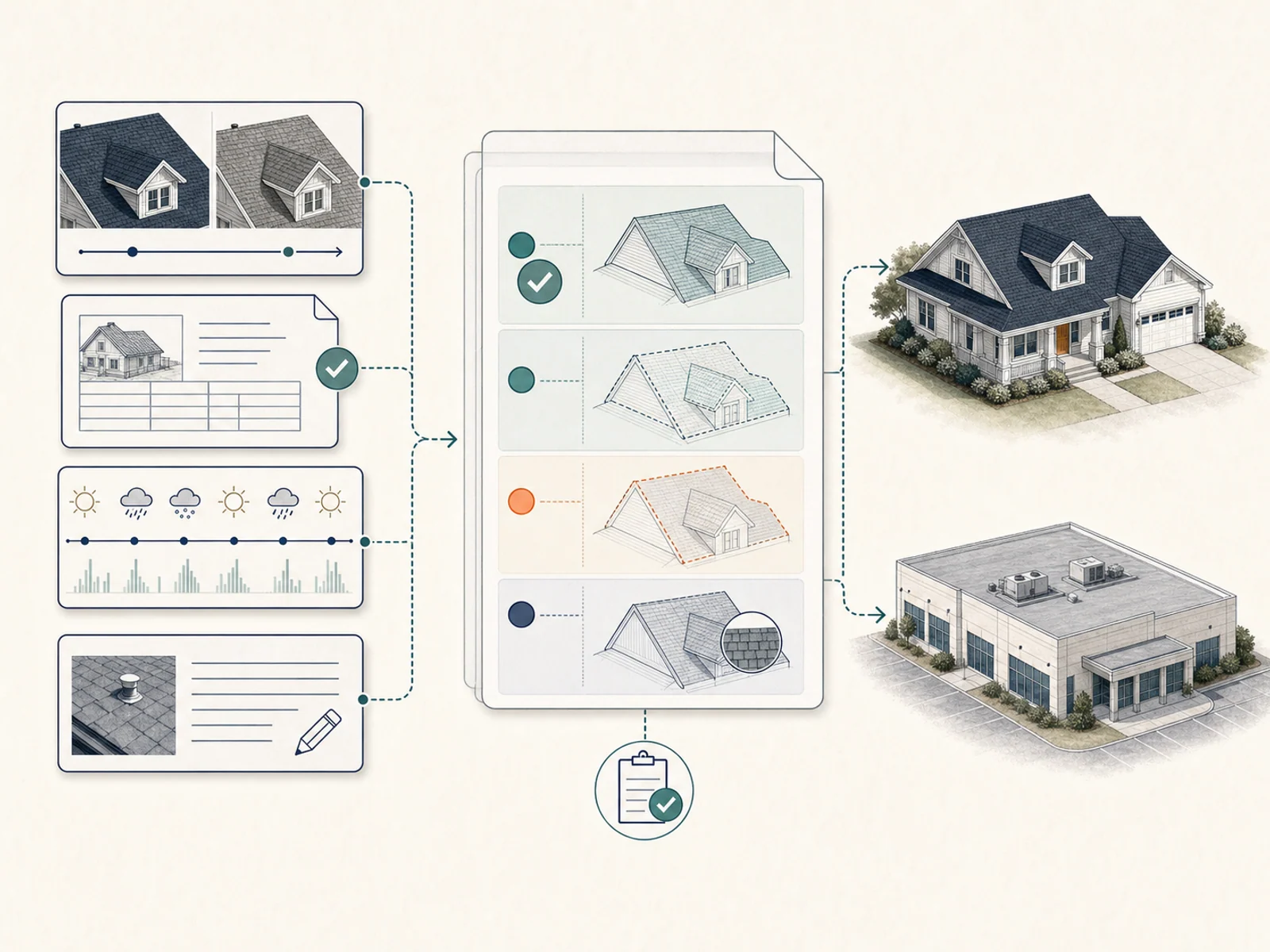
What RoofPredict actually is
RoofPredict is a roof-information and referral service. For homeowners, the service begins with a property-specific Roof Report and a personal phone walkthrough. We organize imagery, available property and permit records, recorded weather history, and the homeowner's context into findings, estimates, open questions, and practical next steps.
When a physical look would improve the answer, RoofPredict may assign one roofing professional from its network. RoofPredict may receive a referral or marketing fee if the homeowner chooses to work with a network company. The Roof Report and walkthrough are free to the homeowner, and there is no requirement to schedule a visit or hire the company.
Coverage and data availability
RoofPredict is expanding across U.S. markets. The depth of a report varies by address because image cadence, resolution, permit access, and machine-readable property records vary by county. A well-covered property may support a narrow age window and a detailed history; another may support only a broad estimate and a list of records or field observations that would improve it.
Here is the scale, precisely. Our sealed imagery catalog holds 14,050,008 roof images covering 2,071,744 U.S. homes. 710,381 of those homes have been photographed on two or more distinct dates and 6.17 million of the images carry a capture date precise to the day, which is what makes a before-and-after read on a single roof possible at all.
14,050,008
roof images in the catalog
2,071,744
U.S. homes covered by those images
710,381
of those homes captured on two or more distinct dates
6.17 million
images carrying a capture date precise to the day
That catalog exists to train and validate our roof-dating models across multiple U.S. metros and multiple years, and it grows with every market we scan. It is not a sample of American housing: it was built where imagery is dense, coverage is uneven from county to county, and its counts describe the catalog rather than the national roof stock. We publish the exact counts so you can weigh what our estimates rest on, rather than take “millions of parcels” on faith.
Professional availability varies by market, service area, and the reason for a visit. If the available information cannot support a conclusion, or an introduction is unavailable for a property, we can discuss what else may help answer the question.
What data we use
- Historical roof imagery
- Successive image captures of the same rooftop over time. When the surface changes color, texture, or pattern between two captures, the roof was very likely replaced in that window. The width of that window sets the width of our estimate.
- Public property and permit records
- County and municipal records, where available and machine-readable, including build year and roofing permits. A permit is the strongest single piece of evidence we can find without visiting the house.
- Recorded weather history
- Publicly recorded hail and wind events for the location, sourced from NOAA's storm reporting. This tells us what a roof has been exposed to. It does not tell us whether that roof was damaged.
- Neighborhood and construction context
- Homes built and re-roofed in cohorts age in cohorts. Where a subdivision was built in one cycle, that context narrows an otherwise wide estimate.
How an estimate is built
- Find the strongest available evidence of the last replacement — a permit record if one exists, otherwise a visible change between two imagery captures.
- Express that evidence as a window rather than a point. Two captures three years apart produce a three-year window, not a single year.
- Widen or narrow the window using context: neighborhood build cohort, property records, and image quality.
- Layer recorded weather exposure separately, as context about what the roof has lived through — never as a claim that damage occurred.
- Hand the whole thing, including the uncertainty, to the inspecting professional. On-site observation overrides our estimate every time.
The estimate is a starting point, not a verdict
A roof-age range tells you whether it is time to look. It does not tell you whether you need a new roof. Only someone who inspects the roof can tell you that, and plenty of old roofs pass.
Residential and commercial roof underwriting models
RoofPredict is building models that help organize roof information consistently before a human makes a decision. The residential model focuses on the roof's likely age, material, replacement history, visible condition signals, recorded weather context, and the homeowner's planning horizon. The commercial model must also track roof sections, low-slope assemblies, drainage, rooftop equipment, repairs, warranties, inspection logs, and the operational consequences of a leak or replacement.
The intended output is an evidence trail, not an unexplained score: what is known, what is estimated, how strong the evidence is, what could change the conclusion, and which questions require physical confirmation. That structure can help homeowners plan, insurers focus prevention and inspection work, lenders understand a collateral question, and roofing professionals arrive with a better-prepared scope. Each party still applies its own rules and professional judgment.
A model should create a correction path
A permit, invoice, inspection report, or verified field observation should be able to correct an estimate. Consequential decisions should not depend on imagery alone when better evidence is available.
When an introduction may help
Sometimes the available records leave questions that need an on-site look. We can discuss an introduction where a roofing professional is available. Here is what that means for your next step:
- If an on-site look would help, we can discuss an introduction where a professional is available
- We explain the reason for the introduction before you decide whether to schedule a visit
- Ask the company about current credentials, insurance, and the written scope before hiring
- Any roofing work is a separate decision and agreement between you and the company
- You choose whether to schedule a visit or hire anyone
An introduction is an opportunity to discuss the work. Compare the company’s written scope, credentials, and terms, then decide whether the company fits your needs.
What this cannot tell you
- We produce a range, not a date. Anyone quoting your roof's exact age without a permit or an invoice is guessing.
- Imagery has gaps. Coverage frequency, resolution, tree cover, and capture season vary widely by location, and thin coverage means a wider range or no estimate at all.
- A partial re-roof can read as a full replacement. Slope-by-slope repairs, or a replacement of only the storm-facing side, can look like a whole new roof from above.
- Recorded storm exposure is not damage. A hail report near your address means hail was reported nearby, not that your shingles were bruised.
- Nothing here evaluates what is under the shingles. Decking, underlayment, ventilation, and flashing condition require someone on site.
- We do not assess insurance coverage or claim eligibility. RoofPredict is not an insurance adjuster or a public adjuster, and we do not file or negotiate claims.
Editorial standards
Our homeowner guides are written by the RoofPredict Research Team and reviewed against these rules before publication.
- Every number in a guide is either sourced to a named organization or explicitly hedged as an estimate.
- We link the sources we rely on, primary wherever they exist — trade associations, federal agencies, research institutes. Where no primary dataset is published, as with residential cost figures, we cite the named industry surveys we actually used and label them as surveys.
- We do not use fear as a conversion tactic. "Your roof is probably fine" is a legitimate conclusion and we publish it.
- Guides carry a visible last-updated date. When a figure changes, we update the guide instead of quietly leaving the old one up.
- We disclose the business model on the page: RoofPredict may receive a referral or marketing fee when a homeowner chooses to work with a network company; homeowners pay nothing for the Roof Report.
- Corrections are made in place, and material corrections are noted in the guide.
Found something wrong? Tell us at info@roofpredict.com and we will correct it.
Want this run on your roof?
Request a free Roof Report for your address. A RoofPredict specialist will call to confirm the property, explain the findings and limits, answer your questions, and decide whether a physical look would improve the answer.
Start my Roof Report