
How To Tell If Hail Damaged Your Roof From The Ground
On this page
You cannot confirm hail damage to a roof from the ground. You can collect clues that make the next conversation safer: storm date, safe photos, collateral dents, spatter, visible missing or lifted material, granules near downspouts, interior stains, and questions.
Quick answer:
| Question | Ground-level answer |
|---|---|
| Can you tell for sure from the ground? | No. Ground clues are observations, not a roof diagnosis. |
| What can you check safely? | Weather context, collateral clues, visible roof changes, interior leaks, and records. |
| What can those clues prove? | They can support inspection questions. They do not prove damage, causation, coverage, warranty approval, or replacement need. |
| When should you stop documenting? | Stop for active water entry, unsafe rooms, gas smell, downed lines, structural movement, or any photo that would require a ladder or roof access. |
This page is for first-pass ground observations only. For a full pre-visit packet, use the homeowner storm damage report before the first visit. For insurer-call triage, use the hail claim evidence checklist. Here, document what can be seen safely and ask for qualified inspection.
NOAA's hail basics explain why hail can damage homes and cars, and the National Weather Service severe thunderstorm page says one-inch hail can damage roofs and vehicles. That context does not prove your roof was damaged. IBHS hail guidance, IBHS roof-cover guidance, Atlas's hail bulletin, and Malarkey's granule bulletin point to signs, look-alikes, delayed effects, and granule-loss limits.
Start With The Safety Boundary
Do the first check only after the severe-weather threat has ended. The National Weather Service after-storm guidance says to keep listening for more severe weather, assess damage after the threat is over, watch for downed lines, and stay out of damaged buildings.
For this workflow, "from the ground" means no ladder, no roof walking, no lifting shingles, no touching power lines, no tarp work, and no entering unsafe rooms. Ready.gov recovery guidance puts health and safety first and flags loose power lines, gas leaks, structural damage, damaged wiring, and unsafe buildings as post-disaster hazards. If you smell gas, see a downed line, see structural movement, or have doubts about whether the home is safe to enter, leave the area and contact emergency authorities, the utility, or qualified local help as appropriate.
CDC/NIOSH ladder safety notes that ladder-related injuries occur at work and at home. OSHA's roof inspection, tarping, and repair guidance is worker guidance, but it explains why roof work belongs outside a homeowner photo checklist: ladders, elevated surfaces, slippery or damaged materials, tools, power lines, and fall hazards.
What Route Should Each Clue Trigger?
Use this route-priority matrix before close-up photos. It is not a severity score, claim rule, or coverage prediction. It keeps urgent issues from getting buried inside a camera roll.
| Priority | Ground clue | Who owns the next step | What to do now | What not to conclude |
|---|---|---|---|---|
| Stop and make safe | downed line, gas smell, unsafe room, structural movement, unstable ceiling, or unsafe access | emergency authority, utility, qualified building professional, or other local help | leave the area, protect people first, and document only from a safe distance | do not inspect the roof or enter unsafe spaces |
| Active leak or exposed opening | active drip, bulging ceiling, visible opening, or exposed roof area seen from the ground | qualified roofer or emergency-repair professional; insurer or agent for process questions when covered property may be damaged | move valuables if safe, take wide and close interior photos, keep receipts, and ask about temporary protection | do not decide hail causation or repair scope |
| Collateral evidence | dents on metal, A/C fins, screens, siding, vehicles, fencing, skylight trim, gutters, or downspouts | qualified roofer or inspector | photograph wide and close, label side of house, and ask the inspector to check nearby roof areas | do not say the shingles are damaged |
| Weather context only | hail heard, local warning, nearby SPC report, or later NCEI event record but limited property clues | homeowner file owner, roofer, insurer or agent if needed | build the storm-date workflow and monitor safely | do not treat storm records as address-level roof proof |
| Dry home and no visible clue | no safe exterior or interior clue and no current leak | homeowner, with optional qualified inspection if roof age or storm severity warrants it | keep a short photo baseline and weather note | do not certify the roof as unharmed |
The table should make one decision easier: safety, leak response, inspection, weather-record organization, insurer or agent process questions, or monitoring.
The Ground-Level Hail Observation Map
Use this map to decide what to photograph, how to label it, and what the clue cannot prove.
| Ground observation | Why it matters | What it cannot prove | Next safe action |
|---|---|---|---|
| dents on gutters, downspouts, metal flashing, chimney caps, skylight flashing, or vents visible from the ground | collateral impact evidence can show hail may have struck exterior surfaces | shingle damage, roof leak cause, coverage, or replacement need | photograph wide and close, label side of house, ask a qualified roofer to inspect nearby roof areas |
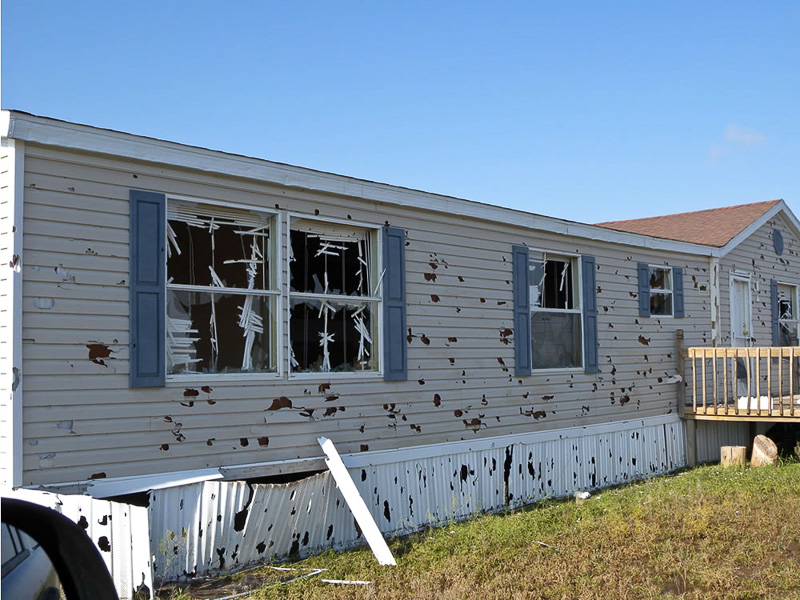
| dents in A/C fins, garage doors, vehicles, fences, patio items, or mailboxes | helps separate "hail in the area" from "hail may have hit this property" | damage to roof slopes or roof age | photograph from safe distance and add date/time |
| spatter marks on oxidized metal or dirty surfaces | IBHS notes spatter can indicate hail knocked oxidation or dirt off a surface | spatter itself is damage or roof damage | label as spatter or possible spatter, not as roof damage |
| torn screens, cracked siding, broken glass, or damaged trim | wind-driven hail can strike vertical surfaces and windows | the roof surface was damaged | photograph the elevation and ask whether a roof inspection should include that side first |
| piles of granules near downspouts, splash blocks, or gutter outlets | granules are worth documenting after hail or heavy rain | hail damage by itself; granules can have age, wear, installation, prior-roof, or other causes | photograph the pile and the downspout location; save roof age and prior repair records |
| missing, lifted, creased, or broken roof material visible from the ground | visible roof changes can be urgent inspection cues | hail as the cause, newness, or repair scope | do not climb for a better angle; call a qualified roofer, and ask your insurer or agent about process if covered property may be damaged |
| ceiling stains, active drips, damp spots, or a bulging ceiling | interior symptoms can change the urgency of the next step | hail causation or the exact leak path | move valuables safely, photograph the room and close-up, and get qualified help if water is active |
| no visible exterior clue | may lower immediate panic if the home is dry and safe | that the roof is unharmed | keep weather context, monitor safely, and schedule inspection if the storm was severe or the roof is older |
The discipline is in the last two columns. A dented downspout can matter. It does not let you say the shingles are damaged. A clear ground view can be reassuring. It does not certify the roof.
How Should You Document The Storm Date?
Weather context belongs beside the photos, not on top of them. NOAA explains hail formation and damage risk. NWS severe thunderstorm guidance adds the one-inch hail threshold.
For recent context, the Storm Prediction Center storm reports are useful, but SPC reports are preliminary. For historical official records, the NOAA/NCEI Storm Events Database contains records used to create NOAA's official Storm Data publication. The NCEI Storm Events FAQ also matters because official records can lag after the end of a data month. A missing same-week NCEI result does not prove there was no hail.
Use this storm-date evidence workflow:
| Step | What to record | Status label | Limit |
|---|---|---|---|
| 1. Homeowner observation | date, approximate time, hail heard or seen, safe hailstone photo if available, side of home where it was noticed | observed by homeowner, not independently verified | does not measure every hailstone or roof impact |
| 2. Recent weather context | local NWS warning, local news alert, or SPC preliminary report for the nearby area | preliminary, nearby, accessed on YYYY-MM-DD | not final official proof and not address-level roof proof |
| 3. Official historical lane | NCEI Storm Events entry when available, event type, county or zone, magnitude if listed, and link | available, pending, not found, or not checked; accessed on YYYY-MM-DD | not a roof diagnosis and not proof of damage at one property |
| 4. Area note | distance or area relationship such as "same county," "nearby city," or "unknown distance" | area note added | avoids implying exact address verification |
| 5. File note | what the weather record will be used for | context only | keeps the record from becoming a claim conclusion |
Good wording: "SPC showed preliminary hail context for the area, accessed May 31, 2026; NCEI record pending/not checked; ground photos show west downspout dents." Weak wording: "Storm report proves the roof was hit."
What Ground Photos Should You Take Safely?
Keep original photos unchanged. If you need arrows or circles, make annotated copies. Use neutral labels such as 2026-05-31-front-gutter-dent-001-original.jpg. If a photo cannot be taken safely, write "not visible from safe ground location" instead of climbing for it.
| Photo or record | Required or optional | Safe location | Label format | If unavailable |
|---|---|---|---|---|
| address or exterior orientation photo | required | sidewalk, driveway, or yard | YYYY-MM-DD-front-wide-001-original |
note why the view was blocked |
| four exterior sides | required when safely visible | ground only | YYYY-MM-DD-west-elevation-wide-001-original |
mark side as not safely visible |
| collateral metal dents | required if present | ground only | YYYY-MM-DD-west-downspout-dent-001-original |
mark "not found" or "not visible" |
| A/C fins, screens, siding, garage door, vehicle, fence, or trim | optional but useful if present | ground only | YYYY-MM-DD-north-ac-fin-dent-001-original |
mark as not present or not visible |
| granules near downspouts or splash blocks | optional if present | ground only | YYYY-MM-DD-south-downspout-granules-001-original |
do not scrape or collect from unsafe areas |
| visible roof change | optional if visible without ladder | ground only, zoom allowed | YYYY-MM-DD-rear-roof-visible-lift-001-original |
write "no safe ground view" |
| interior stain, damp spot, drip, or bulge | required if present and room is safe | floor level | YYYY-MM-DD-living-room-ceiling-stain-001-original |
leave unsafe rooms and document later |
| safety hazard | required if it affects access | safe distance only | YYYY-MM-DD-front-downed-line-001-original |
contact utility or emergency help first |
| receipts and temporary-protection records | required if work or purchases occur | document scan or photo | YYYY-MM-DD-receipt-emergency-protection-001-original |
note missing record |
| qualified inspector photos | required after inspection if provided | supplied by roofer or inspector | keep their location labels intact | ask for roof slope/elevation labels |
This checklist is useful because it preserves both evidence and limits. A missing photo should not become a guess. A safe "not visible" label is stronger than an unsafe close-up.
What Still Needs A Qualified Roof Inspection?
The ground view cannot answer the hardest roof questions. It cannot tell whether a shingle has a bruise, fracture, tear, mat damage, seal issue, or functional damage. It cannot tell whether a mark is hail, blistering, foot traffic, age, installation damage, manufacturer defect, wear, or old storm damage.
IBHS describes asphalt shingle hail damage modes such as denting, tearing or breach, and granule displacement. Atlas gives manufacturer-specific examples such as depressions, dents, scarring, granule loosening, delayed granule loss, and hidden substrate rupture. Malarkey adds an important limit for homeowners: granules in gutters or near downspouts can come from installation-related excess granules, normal weathering, prior-roof residue, high winds, or hail storms, and severe weather should lead to a professional inspection.
That does not mean every hailstorm damages every roof. It means the roof-surface question belongs to a qualified inspection. Ask the roofer or inspector to separate hail, wind, age, weathering, installation, maintenance, manufacturer, and unknown conditions.
The inspection summary should state its limits. A written summary that maps photos by roof slope, elevation, and condition category is much more useful than unlabeled close-ups.
Build A Three-Lane Evidence File
Do not send a messy camera roll. Build a small file with three lanes.
| Lane | What to include | Good wording |
|---|---|---|
| weather context | date, time, local warning, SPC context, NCEI record when available, accessed date, database status, safe hailstone photos | "hail reported near the property on May 21; NCEI pending as of May 31" |
| property observations | orientation photos, collateral dents, spatter, screens, siding, downspouts, granules, visible roof changes, interior signs | "west downspout dent visible from ground" |
| questions | roof age, inspection areas, active leak status, insurer or agent process question, missing documents | "does this area need closer roof inspection?" |
FEMA's severe-weather documentation guidance supports photos and videos of damage inside and outside, receipts, serial numbers, and material samples. CFPB disaster guidance tells consumers to contact the insurer when property that may be covered was damaged, ask for a policy copy if needed, and take photos or videos when possible. NAIC claims-process guidance supports documenting losses, keeping receipts, contacting the insurer or agent, and understanding adjuster and mortgage-lender process.
Use those sources for documentation discipline, not as a promise that insurance will pay for a roof, temporary protection, or any repair.
Questions To Ask The Roofer Or Inspector
A good inspection request is specific and does not pressure the roofer to confirm a claim outcome.
Ask:
- Can you inspect the roof without me using a ladder or getting on the roof?
- Which ground-level clues should you inspect closest?
- Will your photos be labeled by roof slope, elevation, or area?
- Will you separate hail, wind, age, wear, installation, maintenance, manufacturer, and unknown conditions?
- Did you see collateral evidence that supports hail at the property?
- Did you see roof-surface conditions that need urgent protection?
- What findings are visible, what findings are inferred, and what remains unknown?
- Will your written summary say what the inspection did and did not evaluate?
The CFPB's contractor guidance after a disaster supports references, written estimates, credentials, insurance, permits, signed contracts, records, receipts, and process questions. The FTC's weather-emergency repair-scam guidance adds a practical boundary: do not rely on a contractor to tell you what insurance covers, do not sign an insurance check over to a contractor, and avoid blank contracts or pressure tactics. That is not a reason to distrust every roofer. It is a reason to keep the conversation written and evidence-based.
When A Local Ground-Level Hail Page Is Worth Publishing
A city or state ground-observation page is useful only when the local facts change what should be photographed, how a roofer should triage the lead, or which service-area capabilities matter. The page should help a roofing company sort real post-storm intake rather than reassure a homeowner with a familiar city name.
Start with the physical market. A dense suburb with asphalt shingle tract homes, mature trees, attached gutters, and repeated spring hail may need a different checklist than a rural service area with long drive times, metal roofs, farm outbuildings, wind-driven hail, and limited same-day inspection capacity. A coastal market with mixed wind and hail should separate wind-lift clues from impact clues. A mountain or Front Range market may need steep-slope access, fast storm movement, wildfire-adjacent material questions, and county-level report-distance discipline. A historic district or HOA-heavy city may need a stronger permit, material-match, and exterior-visibility lane before a contractor writes the inspection plan.
Use this local-page test:
| Local signal | What the page should add | Roofer use |
|---|---|---|
| Storm path and timing | Recent hail/wind context, SPC/NCEI status, local warning references, report-distance limits, and update-lag notes. | Prioritize route lists and avoid overpromising address-level storm proof. |
| Roof stock | Local roof age, dominant materials, pitch, tree cover, attached structures, gutters, skylights, vents, and common collateral surfaces. | Tell dispatchers what clues matter before scheduling the inspection. |
| Access and safety | Local terrain, alley/driveway access, multi-story neighborhoods, manufactured homes, outbuildings, or storm debris conditions. | Route urgent jobs to crews with the right equipment and safety workflow. |
| Insurance-adjacent process | State-specific questions homeowners should ask insurers or agents without giving legal advice or claim strategy. | Keep sales notes from becoming coverage promises. |
| Contractor directory fit | Storm response, emergency protection, roof type, inspection availability, drone/photo workflow, service radius, and adjuster-meeting capability. | Match homeowners to contractors who can actually handle that market. |
| Economic and seasonal pressure | Material lead times, crew capacity, hail-season timing, post-storm demand, and roof replacement age bands. | Help owners decide whether a local brief, newsletter CTA, or directory CTA is useful. |
Good local pages can also be clever about origin and topography. A city that grew through 1990s subdivisions has different roof-age and shingle-line questions than a city with older bungalow neighborhoods. A valley, ridge, lake-effect corridor, or open Plains exposure can change wind direction, collateral evidence, and report interpretation. A market with many second homes, rentals, or absentee owners may need stronger photo-labeling and permission notes. A place with frequent oil, gas, agricultural, or logistics employment shifts may have timing pressure around deductible conversations, payment scheduling, crew availability, and material demand, but those details need sources and careful financial boundaries.
If the local facts do not change the checklist, do not force a separate URL. Merge the detail into a state market brief, a storm-response hub, or the contractor directory metadata. If the facts do change the workflow, make the page stand on its own with local evidence, contractor operations, source limits, and internal links.
Where RoofPredict Fits
RoofPredict should help organize the observation file. A useful RoofPredict ground-level hail packet can frame roof age, storm exposure, safe photo labels, property-side observations, interior signs, follow-up routes, reports, questions, and missing information.
RoofPredict does not diagnose hail damage, certify functional damage, determine hail causation, decide insurance coverage, approve a warranty claim, or replace a qualified roof inspection. Its value is structure: reviewers can see what was observed, where it was observed, what source supported the context, and what still needs review.
Related RoofPredict Workflows
Use this page for "what can I see safely from the ground?" Use these related RoofPredict workflows for adjacent jobs:
| If the job is... | Use this workflow |
|---|---|
| building a complete pre-visit storm packet | Homeowner storm damage report before the first visit |
| deciding whether to call the insurer after hail | Should you file a roof insurance claim after hail? |
| functional versus cosmetic language | Functional versus cosmetic roof damage |
| adjuster visit or virtual review prep | Insurance adjuster roof inspection prep |
| granule loss, blistering, or cracking photos | Granule loss, blistering, and cracking photos |
| reusable post-storm report format | Homeowner roof damage report template |
Checklist Before You Share The File
Use this before sending photos to a roofer, insurer, or adjuster.
- Confirm the severe-weather threat has ended.
- Stay off the roof and avoid ladder photos.
- Stop for downed lines, gas smell, unsafe rooms, active structural movement, or other unsafe conditions.
- Take four wide exterior orientation photos if safely visible.
- Photograph dents, spatter, screens, siding, A/C fins, downspouts, and visible roof changes from the ground.
- Photograph interior stains or leaks with one wide room photo and one close-up if the room is safe.
- Label every photo by date, side of house or room, condition, number, and original/annotated status.
- Keep weather records in a separate context lane with accessed date and database status.
- Mark granules as an observation, not a diagnosis.
- Save roof age, prior repair, warranty, receipt, and inspection records if available.
- Ask the roofer for labeled photos and a written summary.
- Ask the insurer or agent process questions if property that may be covered appears damaged.
- Use RoofPredict to organize the file, not to decide what the evidence proves.
Source Limits
| Source | What it supports | What it does not support |
|---|---|---|
| NOAA/NSSL and NWS severe thunderstorm guidance | hail formation, severe-hail context, roof and vehicle damage risk | proof one roof was damaged |
| NWS after-storm guidance, Ready.gov, CDC/NIOSH, and OSHA | safe timing, reentry caution, ladder-risk context, downed lines, damaged buildings, gas leaks, structural hazards, and roof-work hazards | homeowner roof work, roof diagnosis, or unsafe photo-taking |
| SPC storm reports | recent preliminary storm context | final official records or address-level proof |
| NOAA/NCEI Storm Events and NCEI FAQ | official storm-event record lane and update-lag boundary | immediate same-day verification, completeness promises, or property-specific roof causation |
| IBHS hail guidance | collateral indicators, spatter limits, look-alikes | homeowner roof-surface diagnosis |
| IBHS roof-cover guidance, Atlas hail bulletin, and Malarkey granule bulletin | roof damage modes, delayed effects, granule-loss ambiguity, and inspection questions | universal brand rules, coverage, warranty approval, or ground-photo diagnosis |
| FEMA, CFPB, and NAIC | documentation, photos, receipts, insurer process, mortgage caveats | legal advice, coverage promises, or reimbursement guarantees |
| CFPB and FTC contractor guidance | references, written estimates, credentials, insurance, written contracts, records, receipts, and insurance-process boundaries | claim that every contractor is suspect or that a contractor can decide coverage |
| RoofPredict | organizing roof age, storm context, safe photos, reports, routes, and questions | hail diagnosis, coverage, warranty approval, repair scope, or inspection replacement |
FAQ
Can I tell from the ground if hail damaged my roof?
No. You can collect useful clues from the ground, but roof hail damage needs qualified evaluation. Ground clues should help frame inspection questions and urgency discussions, not replace inspection.
Do dented gutters mean the roof is damaged?
No. Dented gutters, downspouts, metal flashing, or A/C fins can indicate hail hit exterior surfaces. They do not prove shingle damage.
Does quarter-size hail mean my roof has damage?
No. Quarter-size hail is severe-weather context. It gives you a reason to document and ask better questions, but it does not prove damage at your address.
What if NCEI does not list the storm yet?
Mark the NCEI lane as pending, not found, or not checked, with the accessed date. Official records can lag, and a missing current result does not prove there was no hail.
Are granules near the downspout hail damage?
Maybe, but not by themselves. Granules can be related to hail, wind, age, wear, installation, prior-roof residue, or other conditions. Photograph them and ask for inspection context.
What photo label should I use?
Use date, location, condition, sequence number, and original status, such as 2026-05-31-west-downspout-dent-001-original.jpg. Keep annotated copies separate from originals.
Can RoofPredict diagnose hail damage?
No. RoofPredict can organize storm context, roof age, ground photos, interior signs, reports, and questions. It cannot diagnose hail damage, decide coverage, or replace a roofer, inspector, adjuster, or manufacturer review.
The Roofline by RoofPredict
Stay Ahead of Roofing Market Changes
Join The Roofline by RoofPredict for weekly roofing intelligence: material price signals, storm demand, insurance and regulatory updates, sales tactics, and local contractor opportunities.
Sources
- Severe Weather 101: Hail Basics — nssl.noaa.gov
- Severe Thunderstorm Safety — weather.gov
- What to Do After Severe Weather — weather.gov
- Recovering from Disaster — ready.gov
- Ladder Safety — cdc.gov
- Roof Inspection, Tarping, and Repair — osha.gov
- Storm Events Database — ncei.noaa.gov
- Storm Events Database - FAQ — ncei.noaa.gov
- Storm Prediction Center Storm Reports — spc.noaa.gov
- Is It Hail Damage? — ibhs.org
- Natural Weathering and Hazard Exposure — ibhs.org
- Detecting Hail Damage on Asphalt Shingles — atlasroofing.com
- Asphalt Shingles and Granule Sloughing — malarkeyroofing.com
- What should I do after a disaster to protect my finances and property? — consumerfinance.gov
- How to Document Damages After Severe Weather Events — fema.gov
- Navigating the Claims Process: Recover & rebuild — content.naic.org
- How can I find and work with contractors to rebuild after a disaster? — consumerfinance.gov
- How To Avoid Scams After Weather Emergencies and Natural Disasters — consumer.ftc.gov
- RoofPredict — roofpredict.com
Related Articles
How To Build A Homeowner Storm Damage Report Before The First Visit
A homeowner storm damage report is a safe pre-visit handoff for the roofer. It should tell the roofer what happened, what you observed, what photos and documents you have, and what still needs inspection.
Should You File A Roof Insurance Claim After Hail? Evidence Checklist
There is no safe universal answer to "should I file a roof insurance claim after hail?" The better first step is to build a pre-filing evidence file: safety status, visible property evidence, storm-date context, roof age, receipts, policy questions,...
What To Ask A Roofer Before Signing A Storm Damage Contract
Before signing a storm damage roofing contract, ask questions that force the important answers into writing: who the contractor is, what work is included, what is excluded, what changes the price, what payments are due, what storm date and photos support...