
El Nino, La Nina, and Hail Demand: What Roofing Sales Teams Can Safely Say
On this page
Short Answer
Roofing sales teams can talk about El Nino, La Nina, and hail demand when they keep the language in the right lane. ENSO can support seasonal planning, sales training, source monitoring, and customer education. It cannot prove that hail hit a roof, that a neighborhood needs replacements, that a claim will be approved, or that a product will prevent damage.
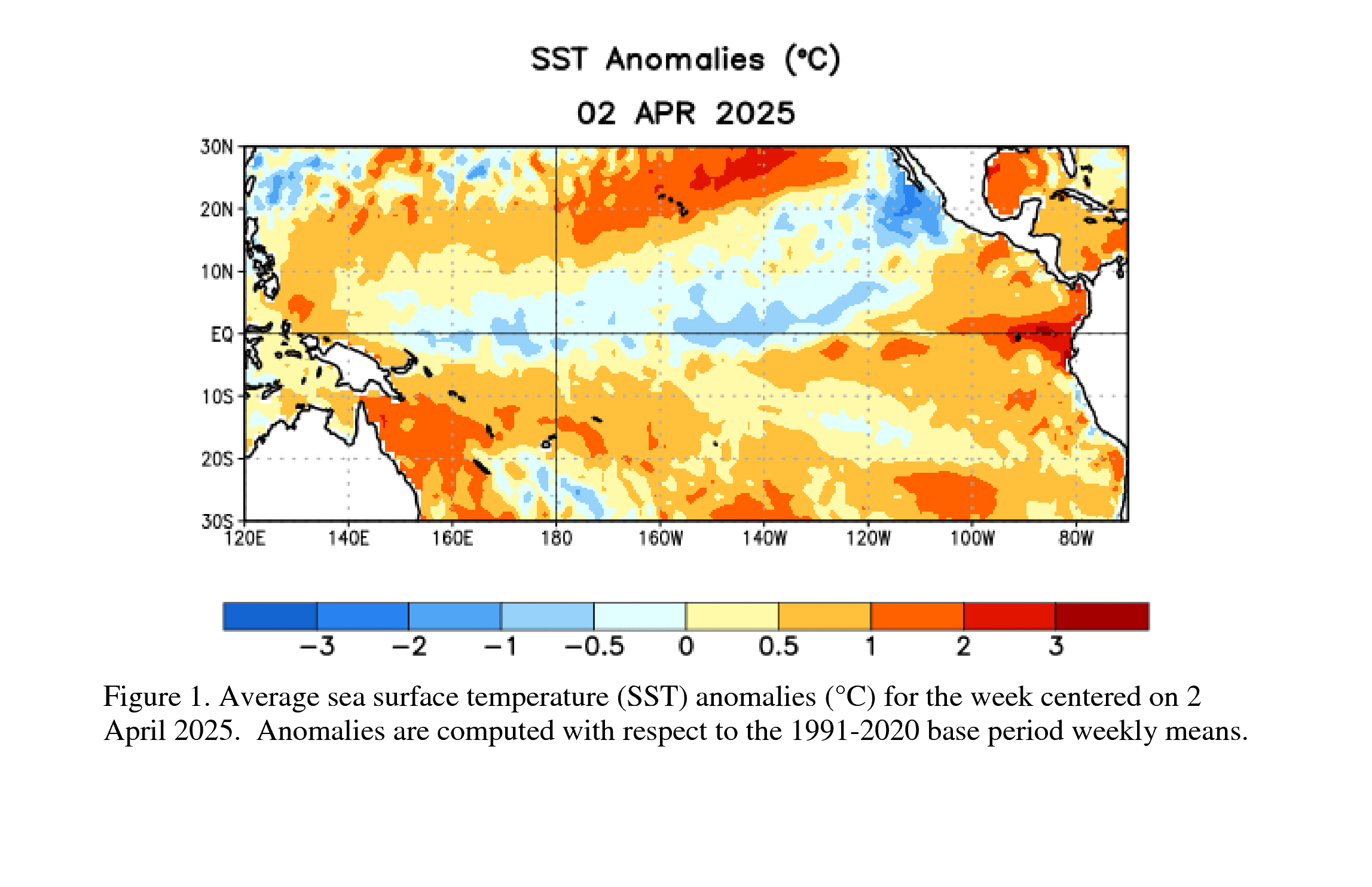
As of June 9, 2026, the latest NOAA CPC ENSO Diagnostic Discussion reviewed for this package was dated May 14, 2026. CPC described ENSO-neutral conditions, kept an El Nino Watch, said El Nino was likely to emerge soon, and said peak strength remained uncertain. Sales teams can use that as scenario context. They should not call a Super El Nino confirmed, promise hail demand, or use ENSO as a door-knocking proof point.
Sources checked: June 9, 2026.
The Sales Rule
The safest sales rule is simple: climate context can explain why the company is prepared; local evidence explains why one customer should be evaluated.
That distinction changes the whole sales meeting. The trainer is not asking reps to memorize ocean-temperature language. The trainer is deciding which phrases are allowed before a storm, after a local storm report, after an inspection, and after a reviewer has looked at the file.
| Situation | Safe sales language | Do not say |
|---|---|---|
| Seasonal planning | "ENSO can shift some seasonal patterns, so we are reviewing hail intake and follow-up rules." | "El Nino means hail is coming here." |
| Local storm report | "There are local reports worth matching to customer calls and property records." | "This report proves your roof is damaged." |
| Customer asks about a claim | "Coverage depends on the policy, evidence, and the carrier process." | "This should be approved." |
| Product discussion | "Impact resistance is a relative product-performance factor under test conditions." | "This roof will be hail proof." |
| Route release | "We are opening a monitored route because local evidence and calls justify follow-up." | "The climate pattern created demand in this neighborhood." |
The rep's job is not to make the weather bigger. The rep's job is to keep the customer's file cleaner than the competitor's file.
What ENSO Can Support
The NOAA Climate.gov ENSO overview and NWS ENSO information explain ENSO as a recurring Pacific climate pattern with El Nino, La Nina, and neutral phases. The NWS page also warns that composites are not forecasts. That warning belongs in sales training because sales pressure often turns "higher odds" into "will happen."
Use ENSO context to support:
- pre-season sales training;
- hail desk readiness;
- route-release rules;
- call scripts and email boundaries;
- storm-documentation checklists;
- material talking points;
- state or market brief planning;
- internal staffing and follow-up reminders.
Do not use ENSO context to support:
- a claim that hail will hit a city;
- a claim that La Nina or El Nino caused one roof condition;
- a replacement recommendation;
- a policy or warranty outcome;
- a neighborhood damage percentage;
- a contractor scarcity warning;
- a product guarantee.
The Climate.gov spring tornado and hail explainer is useful for broad severe-weather context. It should not become a local hail map.
The Four Evidence Lanes
Sales managers should train reps to sort every hail conversation into four lanes.
| Lane | Source | What it allows | What it does not allow |
|---|---|---|---|
| Seasonal context | CPC, Climate.gov, NWS ENSO material. | Prepare scripts, staffing, and monitoring. | Local hail, damage, claim, or replacement claims. |
| Event context | SPC reports, NWS local reports, customer timing. | Open a market file and match dates. | Roof-specific damage conclusions. |
| Property evidence | Photos, inspection notes, roof age, material, collateral marks. | Discuss observed conditions and next steps. | Claim approval or guaranteed scope. |
| Reviewer decision | Sales manager, estimator, carrier, engineer, code official, or other responsible reviewer. | Move the file to estimate, claim lane, repair, monitor, or close. | Replacing the customer's own policy, contract, code, or legal process. |
The SPC same-day storm reports can help teams monitor local hail, wind, and tornado reports after an event, but same-day reports are preliminary. Treat them as event context, not a sales conclusion.
What Reps Can Safely Say
Give reps exact language. Do not leave them to improvise around a complicated climate term.
Use:
El Nino and La Nina can influence seasonal weather patterns, but they do not prove what happened to one roof. We use official storm context, safe photos, roof age, material information, and inspection notes before discussing scope.
Use:
There were local hail reports worth checking against your property timeline. That is a reason to document the roof carefully, not a promise that damage or coverage exists.
Use:
Impact-resistant shingles can be part of a material conversation, but no roof should be described as hail proof. Product terms, warranty terms, and insurance discounts need separate review.
Avoid:
- "La Nina means more hail jobs are coming."
- "El Nino damaged roofs in this area."
- "The storm report proves replacement."
- "Your insurer should cover this."
- "You need to file a claim."
- "This product prevents hail damage."
- "We know your roof is damaged before we inspect it."
The safest script is specific enough to be useful and restrained enough to be true.
Sales Manager Review Checklist
Before a rep uses an ENSO or hail-demand claim in a script, email, door hanger, ad, call opener, or estimate note, the sales manager should check five things.
- Source date: does the current CPC/NWS language still support the seasonal statement?
- Source lane: is the statement about climate context, local event context, property evidence, or a reviewer decision?
- Customer pressure: does the statement create urgency without evidence?
- Claim boundary: does the statement imply insurance, warranty, financing, discount, or legal outcomes?
- Product boundary: does the material language describe relative performance rather than hail-proof protection?
If the answer is unclear, the statement should not go to the field.
The FTC weather emergency guidance is a useful reminder that post-weather repair pressure is a consumer-risk zone. RoofPredict content should help reputable contractors document and explain. It should not give reps fear language.
Hail And Material Language
Hail demand often gets tied to product sales. Keep that conversation narrow.
The NSSL hail research page supports the idea that hail detection and reporting involve complex weather observation and verification. The NSSL hail forecasting page explains that hail formation depends on storm ingredients such as updraft strength and supercooled water. Those sources help reps understand why a broad seasonal signal is not roof proof.
The IBHS asphalt shingle impact-resistance research supports relative product-performance discussion under controlled testing. It does not support "hail proof" sales language, universal warranty promises, or claim approval statements.
Use this product lane:
| If the customer asks | Say this |
|---|---|
| "Should I upgrade because of hail?" | "We can compare material options after we know roof condition, budget, product documents, and local risk context." |
| "Will impact resistance stop damage?" | "It can improve relative performance under certain test conditions, but it is not a guarantee against all hail damage." |
| "Will insurance discount this?" | "Discounts and coverage terms vary. That needs policy and carrier review." |
Local And State Sales Pages
City and state hail-demand articles can be strong when they change the sales workflow. They should not be weather-name swaps.
A local version deserves to exist when it can explain:
- the market's hail season and severe-weather pattern;
- local roof stock, age, and material mix;
- subdivision buildout and replacement timing;
- storm-report and NWS office boundaries;
- state insurance, public-adjuster, or contractor-solicitation rules;
- permitting, inspection, or code details that affect scope language;
- supplier and crew capacity after large hail events;
- oil/asphalt, diesel, disposal, decking, metal, or underlayment cost pressure where sourced;
- contractor directory proof fields that help a customer compare documentation quality.
The local planning note should be blunt:
This page deserves to exist because reps in this market need a different script, source set, route gate, material conversation, or directory proof standard than reps in the next market.
If the local page cannot answer that, keep the national sales-language page as the canonical lane and hold the local draft.
RoofPredict Fields For Sales Discipline
RoofPredict fits the sales-language workflow as a record-quality and routing layer.
Useful fields include:
- ENSO source date;
- storm report source;
- customer call date;
- roof age or install year;
- material and slope notes;
- collateral observation notes;
- inspection status;
- phrase used with customer;
- claim-language stop note;
- route release status;
- follow-up owner;
- reviewer lane.
The product should not be positioned as a weather forecaster, hail detector, roof inspector, insurer, adjuster, engineer, safety authority, legal advisor, warranty authority, or replacement recommendation engine.
Safety Boundary
Sales language should never instruct homeowners to climb on a roof for proof. The OSHA residential fall-protection guidance supports keeping roof-access safety out of casual customer instructions. Ask for safe ground photos, interior leak photos, date notes, and permission to schedule qualified inspection where appropriate.
That safety line also protects sales quality. A rep who asks for dangerous proof is usually trying to fill an evidence gap with pressure.
FAQ
Can a sales team say La Nina is linked to more hail?
It can say official climate sources discuss ENSO links to spring tornado and hail frequency in some regions. It should not say La Nina will create local hail demand, damage a specific roof, or justify a claim.
Can a sales rep mention El Nino in a customer call?
Yes, if the mention is framed as seasonal context and quickly moves to local reports, safe documentation, roof age, material, and inspection notes. El Nino should not be the reason for a replacement recommendation.
Can RoofPredict rank city and state hail pages?
City and state pages are valid when they are specific. They need local sources, roof stock, storm pattern, regulation, insurance, material, supplier, directory, and sales-process differences. A city name swap should stay unpublished.
Where does RoofPredict fit?
RoofPredict can organize source dates, lead context, property records, route status, script notes, reviewer lanes, and follow-up ownership. It should not be described as a forecast source, claim advisor, or automatic replacement decision.
The Roofline by RoofPredict
Stay Ahead of Roofing Market Changes
Join The Roofline by RoofPredict for weekly roofing intelligence: material price signals, storm demand, insurance and regulatory updates, sales tactics, and local contractor opportunities.
Sources
- NOAA CPC ENSO Diagnostic Discussion — cpc.ncep.noaa.gov
- NWS Wichita El Nino and La Nina Information — weather.gov
- NOAA Climate.gov ENSO Overview — climate.gov
- El Nino and La Nina affect spring tornadoes and hailstorms — climate.gov
- SPC Today's Storm Reports — spc.noaa.gov
- NSSL Hail Research — nssl.noaa.gov
- NSSL Severe Weather 101: Hail Forecasting — nssl.noaa.gov
- IBHS Relative Impact Resistance of Asphalt Shingles — ibhs.org
- FTC How To Prepare for a Weather Emergency While Avoiding Scams — consumer.ftc.gov
- OSHA Fall Protection in Residential Construction — osha.gov
- RoofPredict — roofpredict.com
Related Articles
Monthly ENSO Briefing Template for Roofing Companies
Use one monthly ENSO briefing to turn official source updates into operations, safety, customer-language, route, and RoofPredict workflow decisions.
How Strong El Nino Talk Can Mislead Roofing Teams
Strong-event language can help planning, but it misleads teams when it turns into storm guarantees, route shortcuts, claim promises, or unsafe customer scripts.
The Difference Between El Nino Risk and Roof Damage Proof
Climate risk can justify readiness, but roof damage proof still needs local storm context, property-specific inspection records, and clear reviewer boundaries.